January 25th, 2011 at 9:28 am
Ramirez Cartoon: Give Me Liberty or Give Me…Civility?
Below is one of the latest cartoons from two-time Pulitzer Prize-winner Michael Ramirez.
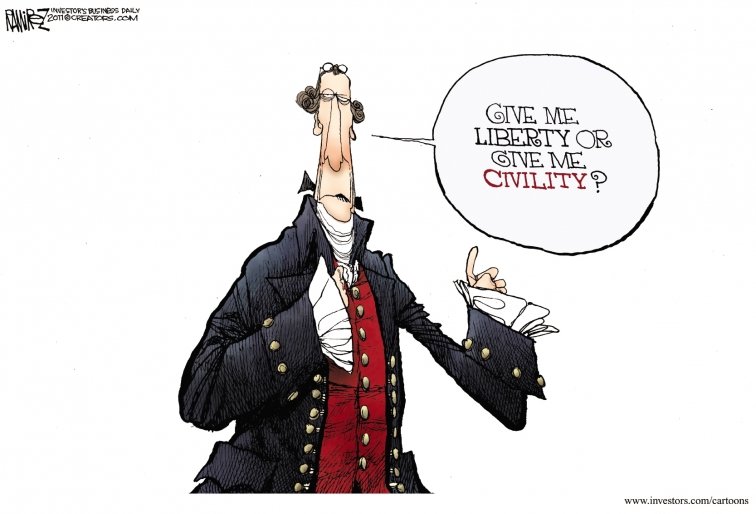
View more of Michael Ramirez’s cartoons on CFIF’s website here.

Below is one of the latest cartoons from two-time Pulitzer Prize-winner Michael Ramirez.
View more of Michael Ramirez’s cartoons on CFIF’s website here.
As President Obama uses Tuesday night’s State of the Union address to attempt a pivot to the center (a topic you can hear me discuss at length with my fellow former White House speechwriters Peter Robinson and Bill McGurn in last week’s Ricochet podcast), newly minted Speaker of the House John Boehner is preparing to call the president’s bluff by teeing up an offer that the president — who has long claimed to be a proponent of education reform — shouldn’t be able to refuse: the renewal of school vouchers in Washington, D.C.
D.C. schools have long had a reputation as the nation’s worst. In response, a five year pilot program of Opportunity Scholarships (a fancy term for school vouchers) was begun in 2004. Then, in 2009 — despite years of positive results — an overwhelmingly Democratic Congress bent to the will of the teachers’ unions and shut the program down. Ninety percent of the children who had to leave the program then found themselves back in failing D.C. schools.
If Speaker Boehner has his way, that trend will be coming to an end soon. According to a story in Politico:
The day after President Barack Obama makes education a centerpiece of his State of the Union address, House Speaker John Boehner will try to force his hand on the issue of school vouchers in Washington, D.C. as a test of the White House’s commitment to bipartisanship.
The Ohio Republican, along with Sen. Joe Lieberman (I-Conn.), will introduce legislation on Wednesday to reauthorize the D.C. Opportunity Scholarship program, the speaker’s office said Monday, making a school voucher initiative that Democrats, including Obama, have strongly opposed as a bargaining chip for beginning discussions on the administration’s desired education proposals.
It’s likely that the media won’t say much — or at least won’t say it for long — if this proposal doesn’t go anywhere. That’s to their shame. How the Democratic Party can ever expect to be taken seriously in its self-appointed role as defender of the downtrodden is inexplicable if they don’t take action to heal the wounds of poor minority children whose first, best chance at a better life is crushed beneath the weight of government bureaucracy.
Three cheers for textualism rang out when an Illinois state appellate court ruled former Obama White House Chief of Staff Rahm Emanuel ineligible to run for mayor of Chicago. CFIF previously highlighted Emanuel’s dubious residency claims. Then, it was obvious Emanuel did not meet the 1 year Chicago residency requirement because he had been living in Washington, D.C.
Tellingly, no one disputes this now. Instead, Emanuel’s defenders (including the Chicago Board of Elections) support the theory that a candidate’s intent to return should be read-in (i.e. judicially legislated) as an exception to the residency requirement. The state appeals court had none of it. In a straightforward opinion, a 2-1 majority ruled for textual integrity and struck Emanuel’s name from the ballot. Of course, he’s appealing it to the state supreme court, but that shouldn’t deter that body from applying the same plain meaning of the statute to his situation.
No one is saying that Rahm Emanuel can never run for mayor of Chicago, just that he must comply with the legal standards for assuming the office. If that’s too much to ask of Rahm, then maybe it would be too much to expect a faithful application of other laws once he’s in office.
Join CFIF Corporate Counsel and Senior Vice President Renee Giachino today from 4:00 p.m. CST to 6:00 p.m. CST (that’s 5:00 p.m. to 7:00 p.m. EST) on Northwest Florida’s 1330 AM WEBY, as she hosts her show “Your Turn.” Today’s star guest lineup includes:
4:00 p.m. CST/5:00 p.m. EST: Edward Lengel, Author, “Inventing George Washington: America’s Founder, in Myth & Memory”
4:30 p.m. CST/5:30 p.m. EST: Attorney Jon Harris, Ogletree, Deakins, Nash, Smoak & Stewart, P.C., Nashville, TN — Frivolous Lawsuits/Pleading Standards/Due Process and CFIF Amicus Curiae Brief
5:00 p.m. CST/6:00 p.m. EST: Jordan Sekulow, Director of International Operations, American Center for Law and Justice — Iran’s Nuclear Weapons Program
5:30 p.m. CST/6:30 p.m. EST: Lucy Morrow Caldwell, Executive Director of Pass the BBA
Please share your comments, thoughts and questions at (850) 623-1330, or listen via the Internet by clicking here. You won’t want to miss it today!
Are new “assault weapons” bans or pistol magazine limits appropriate responses to the Tucson murders? Airheads from Senator Chuck Schumer (D – New York) to “conservative” commentator Peggy Noonan seem to think so.
If those were effective answers, then one could presumably find evidence that such laws reduce crime. But that’s not the case, says Dr. John Lott, Jr.:
No research by criminologists or economists has found that the either the assault weapons ban or the magazine-size restrictions reduce crime. This is not surprising, as magazines are simply small metal boxes with a spring and are thus very easy to make. Besides, someone planning to harm a large number of people can easily bring two or more loaded guns.”
Indeed, the objective evidence shows that tougher gun restrictions increase crime and violence. Fewer gun restrictions, on the other hand, reduce crime and violence. Just look at Chicago, where everyone from Mayor Richard Daley to former Supreme Court Justice John Paul Stevens predicted “more gun death” and “anarchy” following last year’s McDonald Supreme Court decision overturning that city’s draconian gun laws. Instead, Chicago homicides fell to their lowest level since 1965.
Polls show that the American public understands this. When will people like Peggy Noonan?
The Weekly Standard’s Bill Kristol writes a terrific defense of market forces in selecting the next Republican presidential nominee.
Here are two choice paragraphs:
This vision should be easy for conservatives to embrace. Believers in the free market understand the virtues of competition, of low barriers to entry, and of lots of opportunities for (so to speak) price discovery. We know the superiority of spontaneous order to central planning. But too many GOP bigwigs in Washington who claim to have read Hayek have succumbed to the fatal conceit. They’re meeting nonstop trying to determine for us all now, a year before the first primary—with limited information as to relevant candidate skills and almost no knowledge of next year’s political environment—who the best presidential candidate would be.
Democratic capitalists admire Schumpeter for explaining the virtues of creative destruction. But too many donors to the party of democratic capitalism are huddling in New York this winter figuring out if there isn’t some way to short-circuit this kind of healthy—if messy, to be sure—competition among entrepreneurial candidates testing their skills and their messages. Wealthy individuals who made their fortunes by defying the odds are trying to figure out who’s the odds-on favorite to win the GOP nomination so they can cluster behind him. Businessmen who swear by the virtues of competition decry the fact that there will be lots of competition for the GOP nomination. Shouldn’t they instead welcome the competition, even encourage it by putting a little venture capital behind several nominees to see how they do? Markets work, and political markets work too. At least, they’re better than the alternative.
Read all of Kristol’s argument for robust political competition here as an antidote for the establishment and media’s tendency to call results much too early.
Other than her congressional district, Rep. Michele Bachmann’s (R-MN) true base of support comes from the millions of Tea Party members currently providing the grassroots dynamism of the Republican Party. Bachmann raised so much money last cycle that some pundits think she’s running for U.S. Senate or even president.
The announcement that Bachmann is delivering an unofficial Republican response to President Barack Obama’s State of the Union Address will heighten that speculation. It will also anger the House Republican leadership that continues to pass over Bachmann. First, it voted her down in a bid to be the new chair of the House GOP Conference Chair. Bachmann pressed ahead with her own Tea Party caucus, raising even more money. Now, Rep. Paul Ryan (R-WI) is slated to give the official Republican response, but Bachmann will deliver her own via the Tea Party Express website.
There may not be a way for Bachmann to capitalize on her media stardom, unless she continues to go her own way. This will widen the gap between her and House GOP leadership, but if she wins a Senate seat or the presidency in 2012, the onus will be on leadership to make nice with her.
Surprisingly, former Governor Mike Huckabee (R-AR) comfortably leads all other likely Republican contenders for the party’s 2012 presidential nomination. Though the lead is of dubious predictive value, the Other Man From Hope, Arkansas continues to be a genuine political force attractive to millions of Americans. He did, after all, win the 2008 Iowa caucuses and come within a hair’s breath of winning Missouri’s primary. Had he won the latter, the nomination fight would have boiled down to him and Senator John McCain (R-AZ), with favorable odds for an eventual Huckabee win.
So far, Huckabee says he won’t make a final decision on running until this summer. The reason being his distaste for an 18-month campaign; a distaste shared by many voters. Though Huckabee ran afoul of some fiscal conservative groups for some infrastructure spending increases he implemented as governor, he rightly pointed out that all of them were either mandated by federal judicial rulings, or popularly approved by Arkansas voters.
From all accounts Huckabee is probably the most normal person likely to run for president this cycle. That alone may explain his widespread appeal. Time will tell if it is enough to get him the nomination this time.
H/T: Political Wire
Yesterday, 60 members of the House Republican majority endorsed a bill that would “deregulate” health insurance purchases by allowing consumers to buy plans across state lines. The idea is to let companies compete on a national scale, spreading the risk and lowering premiums. The bill is gaining support as a free market counterargument against ObamaCare’s one-size-fits-all regulation of health insurance.
There is a caveat. In order to liberalize the insurance market, the GOP-sponsored bill must take away the states’ power to regulate insurance. The reason insurance plans cost different amounts in different states is because individual states have different regulatory schemes. Those schemes are the product of public policy decisions hammered out at the state level. Importantly for 10th Amendment limited government types, the plan to “deregulate” the health insurance market comes at the expense of state sovereignty.
Ironically, the only way the House Republicans’ answer to ObamaCare gets passed is through an expansive reading of Congress’ ability to regulate interstate commerce “among the states.” Members of Congress will (or at least should) have to struggle with which conservative principle they value more in this instance: the free market or federalism. In a certain sense, federalism grants to states a public policy monopoly over all issues not expressly contained in the text of the U.S. Constitution. That monopoly drives up prices for consumers in states with costly regulations. Theoretically, if people want to pay less for health insurance, they could move to a state with less costly regulations.
Ideas like federalism have consequences. As the Tea Party-flavored House GOP boards the ship of state, it will be interesting to see which crate of principles the revolutionaries toss over.
H/T: Los Angeles Times

This week’s edition of the Liberty Update, CFIF’s weekly e-newsletter, is out. Below is a summary of its contents:
Senik: 10 Things You Won’t Hear in Obama’s State of the Union
Ellis: Where’s the Border Fence?
Lee: Big Labor, Obama Administration Shift Strategies to Impose Their Agenda
Release: CFIF Files Brief before Supreme Court of Tennessee Urging Standards to Reduce Lawsuit Abuse
Freedom Minute Video: The Beginning of the End for ObamaCare
Podcast: Bestselling Historian: Liberals’ Naivete Has Duped Americans for Decades
Jester’s Courtroom: Potential Acorn Lawsuit May Be Nuts
Editorial Cartoons: Latest Cartoons of Michael Ramirez
Quiz: Question of the Week
Notable Quotes: Quotes of the Week
If you are not already signed up to receive CFIF’s Liberty Update by e-mail, sign up here.
Last month, President Obama’s Federal Communications Commission (FCC) voted by a partisan 3-2 margin to regulate Internet service via Net “Neutrality.” On that date, we predicted,”The FCC’s reckless effort to regulate Internet traffic will now begin a slow death march to ultimate defeat from legal challenges and Congressional action.”
Exactly one month later, the judicial front in that battle is underway.
Yesterday, Verizon Communications challenged the FCC’s rogue vote in the U.S. District Court of Appeals for the D.C. Circuit. That’s the same court that unanimously ruled last April that the FCC doesn’t possess lawful authority to impose Net “Neutrality,” but the FCC defiantly pressed ahead despite that unequivocal ruling. In so doing, the FCC also defied 2-to-1 public opposition and a bipartisan group of 300 from Congress. Obama took to the pages of The Wall Street Journal this week to profess a new commitment to regulatory restraint in pursuit of a healthier economy, job creation and more humble federal government. But his own FCC belies that supposed commitment with its Net “Neutrality” agenda.
Leaders of the new 112th Congress have also committed to overturning the FCC’s destructive attempt to regulate Internet service. Whether the demise of Net “Neutrality” comes legislatively or judicially, it can’t come soon enough for American consumers, investors and employers.
In this week’s Freedom Minute, CFIF’s Renee Giachino challenges the professional cynics in Washington who continue to claim that, despite the House vote this week to repeal ObamaCare, full repeal will never become a reality. Giachino further explains why the skeptics are missing three important points and how the House vote was indeed the beginning of the end for ObamaCare.
 Dr. Paul Kengor, New York Times bestselling author and professor of political science at Grove City College, discusses his new book, Dupes: How America’s Adversaries Have Manipulated Progressives for a Century and how many progressives have unwittingly aided some of America’s most dangerous opponents.
Listen to the interview here.
At The Daily Beast, Leslie Gelb discusses the other January 1961 presidential speech that should get more attention from Americans today. It was delivered by outgoing President Dwight Eisenhower.
Here are the Gelbian nuggets:
(1) Put the national interest ahead of politics
(2) There are no quick fixes to crises
(3) Balance is the best strategy
(4) Beware of spending beyond our means
(5) Guard against the power of special interests
The fifth point is best remembered as the warning against the military-industrial complex. The fourth point seems especially pertinent today with a $14 trillion debt that will surely “mortgage the material assets of our grandchildren (while) risking the loss also of their political and spiritual heritage.”
The entirety of Ike’s farewell address can be found here.
How fitting that on the 50th anniversary of President John F. Kennedy’s inaugural address news of Senator Joe Lieberman’s (D-CT) retirement hits the commentariat. In today’s Senate, Lieberman is the last lion of an old-school approach to being liberal: hawkish on foreign policy, civil rights, and fiscal policy. The statist mindset has so overtaken the modern Democratic Party that it’s hard to imagine “Give ‘em Hell” Harry Truman and Henry “Scoop” Jackson choosing to serve alongside the likes of Barack Obama and Barbara Boxer in what was once called “the most deliberative body in the world.”
Part of the corruption story of a once sane party is the outsize influence of public employee unions. When public employees were allowed to unionize, Democratic politicians found it irresistible to negotiate sweetheart union contracts in exchange for campaign cash and poll workers. After all, the wealth being wasted was just other people’s money.
With the economy sagging, the American people know who to blame. Veteran Democratic pollster Doug Schoen says in today’s Wall Street Journal that if his party doesn’t start scaling back overpromised union benefits, independent voters will continue to vote Republican. For current and future leaders of the Democratic Party looking for direction, it would be a good exercise to meditate on JFK’s famous admonition to “Ask not what your country can do for you. Ask what you can do for your country.”
Below is one of the latest cartoons from two-time Pulitzer Prize-winner Michael Ramirez.
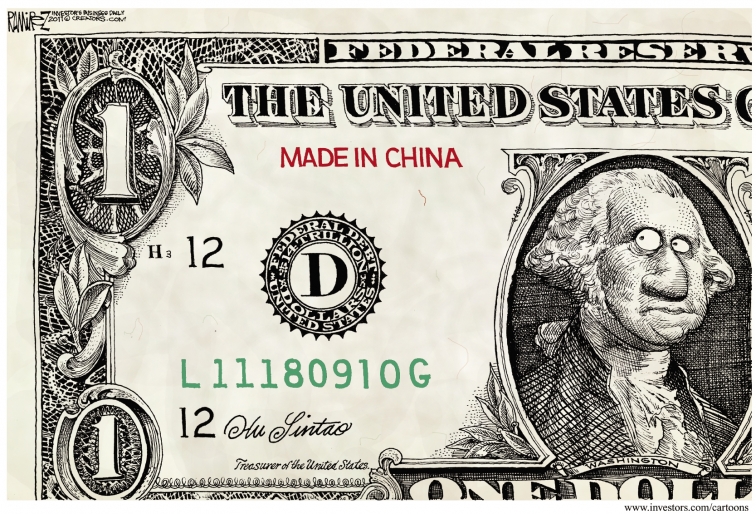
View more of Michael Ramirez’s cartoons on CFIF’s website here.
In an interview in Las Vegas, Senate Majority Leader Harry Reid let fly with the following gem:
“I’m going to go back to Washington tomorrow and meet with the president of China. He is a dictator. He can do a lot of things through the form of government they have.”
One almost wishes to congratulate Reid for the frankness of “dictator”. That’s obviated by the seeming admiration of “he can do a lot of things”, however.
If Reid is truly sweet on Chinese authoritarianism, he’s in good company on the left. Tom Friedman and James Hansen are already at the party. A group not quite as enthusiastic? The Chinese people.
The U.S. House of Representatives just passed H.R. 2, legislation to fully repeal ObamaCare, by a vote of 245-189. Three Democrats — Representatives Mike Ross (AR), Mike McIntyre (NC) and Dan Boren (OK) — joined with all Republicans in support of the repeal measure.
Following up on a previous diagnosis of all that ails California, CFIF Senior Fellow Troy Senik is out today with a prescription for the Golden State to get back on the road to recovery.
Senik’s piece in City Journal doesn’t hold out much hope for newly elected Governor Jerry Brown, but the author does shed light on one proposal that might garner enough votes for a simplified tax code:
California would therefore do well to take the advice of economist Arthur Laffer, not just because of his status as one of the authors of Reaganomics but because he is an example of the state’s woes, having packed up his California-based fund-management business in 2006 and relocated to Tennessee. By Laffer’s estimates, if California abandoned its current, highly progressive income-tax system in favor of a statewide flat tax of no more than 6 percent on personal income and net business sales, it could completely abolish all property taxes, state gas taxes, and state payroll taxes, as well as all current state and local sales taxes, without losing revenue. And that’s without factoring in the increased economic activity that such a dramatic change to the tax code would almost certainly generate. This change would once again require the support of a two-thirds majority in the legislature, but its appeal just might be broad enough to attract such a coalition.
Read the entire article here.
With the 100th Anniversary of Ronald Reagan’s birth approaching next month, Reagan supporters and detractors alike are looking to cash in on our 40th President’s legacy. Sadly, it’s not clear which of those categories his son, Ron Jr., falls into.
In a new book, “My Father at 100”, the junior Reagan claims that his father was suffering the effects of Alzheimer’s Disease during his second term. This is not a new allegation, but it’s one that has usually been limited to liberal innuendo in the past. No publisher worth his salt is going to let a book like this go to press without a pre-release date press bombshell, however, and Reagan’s closeness to his father (genetically speaking, at least) gives this claim more credence than it would otherwise enjoy.
Remarkably, a defense of the Gipper is coming from an unexpected corner of the media. On today’s episode of “The View”, Barbara Walters — who moderated the 1984 presidential debate that the younger Reagan cites as evidence of his father’s deteriorating mental state — came out hard against the allegations. As noted by the Daily Caller, she said:
“Ron, Jr.’s half-brother Michael said this is not true. This didn’t happen,” she continued. “I’m going to say something that I probably saw more of President Reagan in those years than either of his sons. He was not really close to them. And I did interview after interview. I didn’t see any signs of dementia or Alzheimer’s or whatever until after he left office.
After all these years of Joy Behar, Whoopi Goldberg, and Rosie O’Donnell, this is hardly penance for all of “The View’s” shots at conservatism. But it’s not a bad place to start.
 CFIF Freedom Line Blog RSS Feed CFIF Freedom Line Blog RSS Feed CFIF on X CFIF on X CFIF on YouTube CFIF on YouTube |
