Believe it. In an op-ed for BusinessWeek, the scourge of concentrated wealth and power sees a lot to love in the new, Tea Party-infused legislators walking around Capitol Hill. Specifically, Nader isolates five issues that could bring the movement’s limited government mantra into conflict with establishment Republicans.
(1) Ron Paul’s fight to curb the power of the Federal Reserve
(2) Heightened criticism for corporate welfare programs (e.g. everything from ethanol subsidies for biofuel to “green” initiatives designed to get federal tax dollars)
(3) Trimming the military budget (Apparently, Defense Secretary Robert Gates already got the memo; sort of)
(4) Renewal and expansion of the World Trade Organization, NAFTA, etc.
(5) Whistleblower protection for bureaucrats and corporate workers
The limited government foundations of the Tea Party movement will make predicting voting outcomes this session iffier than when Republicans could be assumed to oppose any Democrat plan. If necessary, we’ll see how many of the new Constitutionalists in Congress are ready to buck convention and vote their principles instead of their party.
Rasmussen Reports is out today with some interesting survey results. In the wake of severe budget deficits Americans’ support for public employee unions is sinking to new lows. According to Rasmussen’s telephone survey, 45% of respondents oppose allowing public employees to unionize, while an equal number favor the practice. Just last May, 53% of Americans favored unions for public employees.
The 8% drop in approval rating combined with the rise in outright hostility undoubtedly concerns the mandarins over at the American Federation of State, County and Municipal Employees (AFSCME), the nation’s largest public employee and health care workers union. This kind of growing opposition will surely earn more hysterical charges from AFSCME President Gerald W. McEntee’s like this one that 60 Minutes engaged in media bias when it granted air time to reform Governor Chris Christie (R-NJ).
Judging by this announcement list of top staffers, Senator Marco Rubio (R-FL) thinks highly of people who worked on former Massachusetts Governor Mitt Romney’s (R-MA) failed 2008 presidential campaign. Of eight top staff positions, Rubio gave three to former Romney for President people.
With Romney lining up support for a 2012 presidential run via PAC donations and outsourcing staff to rising Republicans, don’t be surprised if Rubio endorses Romney for the White House. If it comes early enough, it just might be the thing that cinches a Romney-Rubio ticket.
Teagan Goddard of Political Wire repeated a rumor going around about former NYC Mayor Rudy Giuliani (R-NY) getting some of his political hands together for another run at the White House. Presumably, those are the same people that talked their boss into a suicidal primary strategy: skip Iowa, abandon New Hampshire, and bypass South Carolina for an all-or-nothing shot in Florida.
Of course, by the time the Florida primary rolled around, the GOP nomination was a two-horse race between John McCain (R-AZ) and Mitt Romney (R-MA). (Governor Charlie Crist’s late support of McCain sealed the deal for the Maverick’s Sunshine State win.) In the process, Giuliani spent a ton of money effectively not contesting the nomination until it was too late.
And now he wants to do it all again. I’m sure his “brain trust” won’t mind dusting off the 2008 playbook while cashing 2012 checks.
With 2010 now behind us, CFIF’s Renee Giachino presents our predictions for the top five news stories of 2011 in this week’s Freedom Minute. (Note: For our more serious viewers, it’s okay to laugh.)
This morning, the Labor Department announced a national unemployment rate of 9.4%. Unfortunately, this means that the unemployment rate has surpassed 9% for a post-World War II record 20 consecutive months. Moreover, the announcement of just 103,000 new jobs fell well short of the anticipated gain of 150,000 new jobs.
The Obama Administration will trumpet the misleading 0.4% decline from last month’s 9.8% rate as evidence that its agenda is somehow succeeding. That claim, however, conceals the fact that the rate had already dropped from January 2010’s 9.7% rate to 9.5% in June, only to climb back to 9.8% to finish the year. Further, this is the same Obama Administration that promised unemployment would peak at 8% in October 2009 – fourteen months ago – and be down to 7% by now if we just passed his so-called “stimulus” bill back in February 2009. Almost $1 trillion in deficit spending and two years later, the verdict is clear. It has failed miserably.
It’s something to remember as the Obama Administration attempts to “triangulate” and claim successful governance as we steam toward the 2012 reelection campaign.
In a recent interview with CFIF’s Renee Giachino, John Yoo, University of California at Berkeley School of Law Professor and former deputy assistant attorney general in the Office of Legal Counsel of the U.S. Department of Justice, discussed the Obama Administration’s record on issues involving foreign affairs, national security and the separation of powers.
The GOP rank and file may be in love with New Jersey Governor Chris Christie, but there’s one issue on which the Trenton Thunder is out of the Republican mainstream: it seems that he’s the only conservative in America that doesn’t want Chris Christie to run for president.
Yet despite the fact that Christie has repeatedly — and dramatically — forsworn any interest in making a presidential bid, a shocking new Zogby Poll shows that Christie is the Republican favorite for the party’s presidential nomination in 2012, with a whopping 10 point lead over his closest competitor (Mitt Romney). Even more amazing? Christie is the only Republican who currently outpolls President Obama in a general election. Not bad for a man who’s spent one year as the Governor of New Jersey.
Christie’s denials of presidential ambition (at least for this cycle) have been positively Shermanesque. In fact, they’ve been so emphatic that going back on them may undermine his reputation for straight talk. But with numbers like these, look for the Draft Christie movement to catch fire in 2011.
While House Republicans are planning on bringing the repeal of Obamacare to a vote next week, even the staunchest opponents of the healthcare law admit that a fullblown reversal isn’t coming anytime soon.
With that in mind, healthcare analyst Avik Roy lays out the practical implications for conservatives in a piece on National Review Online. Roy is sagacious across the board, but his delineation of the consequences for the 2012 presidential election are especially pertinent — and jarring:
We must remind ourselves of the electoral realities. For Republicans to succeed in repealing the Patient Protection and Affordable Care Act (PPACA), they will need to control the House, the Senate, and the White House. From a political standpoint, if Republicans are not able to achieve this in 2012, they are unlikely ever to repeal Obamacare.
This means that influential Republican activists must — must — coalesce around the most electable Republican presidential candidate who can articulate conservative health-care principles. This is no time for single-issue small-ball or personal score-settling. A GOP nominee who passes all the litmus tests but can’t win in November would only succeed in making Obamacare permanent. One who can win but isn’t capable of pushing for real health-care reform wouldn’t be much better.
Roy is right. Who the Republican nominee is in 2012 could well determine how free of a nation the United States is for the forseeable future. Vote accordingly.
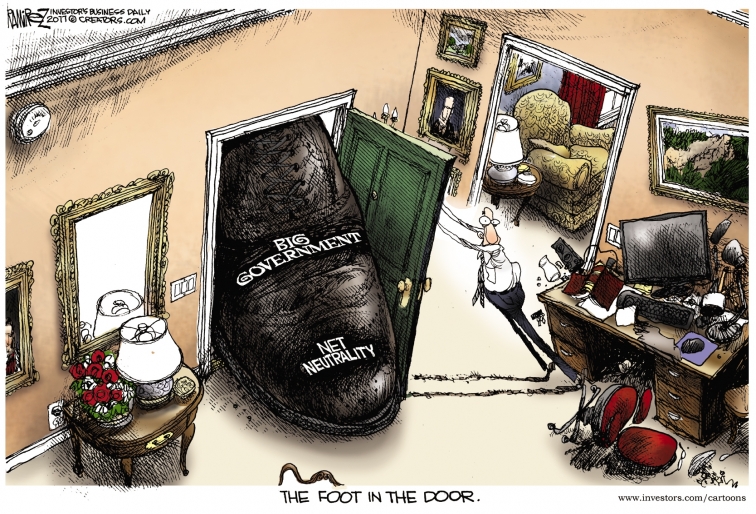
Just prior to the Christmas holiday, the FCC on a 3-2 party line vote approved so-called “Net Neutrality” regulations on the Internet. It did so in the face of overwhelming opposition by the American people, a bipartisan majority in Congress and in defiance of a ruling by the federal courts.
Below is one of the latest cartoons from two-time Pulitzer Prize-winner Michael Ramirez on the issue.
View more of Michael Ramirez’s cartoons on CFIF’s website here.
But it couldn’t happen here. Writing on the online version of the Christian Science Monitor, the Adam Smith Institute’s Jan Iwanik lays out the contemptible plan being used throughout Europe to keep state finances out of the red:
People’s retirement savings are a convenient source of revenue for governments that don’t want to reduce spending or make privatizations. As most pension schemes in Europe are organised by the state, European ministers of finance have a facilitated access to the savings accumulated there, and it is only logical that they try to get a hold of this money for their own ends …
The most striking example is Hungary, where last month the government made the citizens an offer they could not refuse. They could either remit their individual retirement savings to the state, or lose the right to the basic state pension (but still have an obligation to pay contributions for it). In this extortionate way, the government wants to gain control over $14bn of individual retirement savings.
Iwanik then goes on to delineate similar, though less severe plans, in Bulgaria, Poland, Ireland, and France.
Mussolini once summed up his theory of totalitarianism as “All within the state, nothing outside the state, nothing against the state.” Welcome to the millennial version of that philosophy. Who would have thought that Europe’s next generation of fascists would be wearing green eyeshades instead of brown shirts?
According to a blogger at the Huffington PostCalifornia just inaugurated a “Right-Wing Republican” as governor. He’s referring to Jerry Brown, aka ‘Governor Moonbeam’ and the man proposing sharp cuts, tax increases, and budget raids to balance the state’s deficit-ridden balance sheet. In HuffPo world, that combination merits being tarred and feathered as the second coming of another rock-ribbed fiscal conservative, outgoing governor Arnold Schwarzenegger.
Please. If Brown’s budget proposal looks suspiciously similar to Schwarzenegger’s it’s because there are precious few options for governors of any party to try. Sure, nobody thinks they’ll actually solve the problems, but that’s because actually solving California’s budget woes will take some serious undoing of cherished political prizes.
Republicans want to hang onto the 2/3 requirement for passing a budget and maintaining Prop. 13’s cap on property taxes, while Democrats act as though rich (i.e. working) people will pay any price to live within a 100 miles of a beach and subsidize a green welfare state. Neither party is serious about making investments in the state’s infrastructure (e.g. road, power, and water grids), a precondition for economic and social improvement.
The only way California heals its self-inflicted budget wounds is if it repeals all of the constitutional amendments mandating budget appropriations. To do that, Republicans will likely have to agree to end Prop. 13’s property cap, a move that would likely increase property taxes. Though unpalatable to many, removing the cap would return discretion to counties and cities (historically better than Sacramento at balancing budgets) while giving voters an outlet for their displeasure with the next Election Day.
None of this will be easy or popular. Then again, neither is California politics.
When it comes to how a bill becomes a law, the route popularized in most textbooks and School House Rocks is of little value. Instead of clear procedural steps the process is rife with secret votes, waived rules, and last minute amendments that completely change a bill hours before final passage. The failure of the Pelosi-Reid Congress to abide by any semblance of a consistent process made lawmaking into nothing more than the personal whims of liberal elites.
(1) Members introducing new legislation must provide a statement of what powers the Constitution grants to Congress to enact the bill.
(2) Any bill that increases mandatory spending must adhere to a “Cut-As-You-Go” rule requiring the legislation to cut an identical amount of spending elsewhere.
(3) All bills must be posted online in their entirety three days before the House votes on them.
(4) The text of any amendment must be publicly available for at least 24 hours before the House votes on it.
(5) Vote avoidance maneuvers like “Deem-And-Pass” are eliminated. If members want to raise the debt ceiling – or socialize medicine – they must do so on the record.
Rep. David Dreier (R-CA) is fond of saying, “process is substance,” by which he means that how a bill becomes a law is just as important as what is in the bill. Passing House Resolution 5 will go a long way towards restoring the public’s confidence in Congress’s ability to play by a set of fair, easily understood rules. If House Republicans go further and insist on restoring the lost constitutional limits on federal power, they will enjoy a long ride in leadership.
According to the U.S. Treasury, on December 31 the National Debt stood at a whopping $14,025,215,218,708.52, breaking the $14 trillion mark for the first time in our nation’s history. As CBSNews.com reported yesterday:
It took just 7 months for the National Debt to increase from $13 trillion on June 1, 2010 to $14 trillion on Dec. 31. It also means the debt is fast approaching the statutory ceiling [of] $14.294 trillion set by Congress and signed into law by President Obama last February.
Congress must get serious about implementing significant across-the-board spending cuts and it should use the pending vote on the debt ceiling to ensure that happens. Furthermore, we need to stop the bleeding by forcing Congress and the president, via a constitutional amendment, to present and pass a balanced federal budget annually without raising taxes.
Making good on the promise to offer greater legislative transparency and in preparation forthe House vote to repeal ObamaCare scheduled for next week, House Republicans have posted the repeal bill online for all to see.
File E.J. Dionne’s new column paying nominal tribute to the incoming Republican class of congressmen under articles we didn’t finish. The reason? This passage:
There is already a standard line of advice to Speaker-to-be John Boehner and his colleagues that goes like this: Democrats overreached in the last Congress by doing too much and ignoring “the center.” Republicans should be careful not to make the same mistake, lest they lose their majority, too.
This counsel is wrong, partly because the premise is faulty. Democrats did not overreach in the 111th Congress. On the contrary, they compromised regularly. Compromise made the health-care bill far more complicated than it had to be and the original stimulus bill too small. Democrats would have been better off getting more done more quickly and more coherently.
Well, that didn’t take long. Speaker-elect John Boehner (R-OH) and incoming Majority Leader Eric Cantor (R-VA) announced today that the new Republican leadership will make good on its campaign promise to repeal ObamaCare. Next Monday the bill hits the Rules Committee, followed by a Friday floor session deciding the rule for debate. With 242 members, the House GOP is virtually assured of a favorable pro-repeal vote.
But since Democrats still hold the Senate hostage, no actual repeal is happening anytime soon. Right now, though, that isn’t the point. As Politico reports:
The repeal effort is not expected to succeed, given that Democrats maintain control of the Senate and the president can veto the legislation. But Republicans could embarrass the White House if they persuade a number of Democrats to vote with them, and over the long term, plan to try to chip away at pieces of the law.
That yeoman work will begin quickly under new House Government Reform and Oversight Committee Chairman Darrell Issa (R-CA). His sights are set on investigating just about every consequential action by the Obama Administration. Ladies and gentlemen, set your DVRs!




 CFIF Freedom Line Blog RSS Feed
 CFIF on X
 CFIF on YouTube