In taking the Constitution’s oath of office, President Barack Obama solemnly swore to “faithfully execute the Office of President of the United States, and will to the best of my Ability preserve, protect and defend the Constitution of the United States.”
Does faithfully executing the office to the best of his ability include holding our nation’s border security hostage to “comprehensive immigration reform” legislation?
In a truly stunning revelation recorded on video during an Arizona weekend townhall meeting, Senator Jon Kyl (R -AZ) recounted a one-on-one discussion in which Obama explicitly said that border security is a bargaining chip for comprehensive immigration reform, a.k.a. amnesty.
I met with the President, in the Oval Office, just the two of us – I kicked the rest of the people out… Here’s what the President said: ‘The problem is,’ he said, ‘if we secure the border, then you all won’t have a reason to support comprehensive immigration reform.’ In other words, they’re holding it hostage.”
So there you have it. To Barack Obama, our nation’s border security, and its very territorial integrity, is nothing more than an expedient bargaining chip for his partisan political agenda and expansion of his potential voting bloc. That admission occurs just as his Department of Justice plans to sue the state of Arizona for passing an illegal alien statute that merely parallels the existing federal statute.
Less than two years into his tenure, it is becoming increasingly clear that Barack Obama isn’t merely incompetent, but dangerous.
With Day 60 of the Gulf Oil Spill now upon us, Mark Steyn provides a trenchant diagnosis of the mental state directing President Barack Obama’s approach to governing:
The UN, Greenpeace, Amnesty International, Bono: these are the colors a progressive worldly westerner nails to his mast. You don’t need to go anywhere, or do anything: You just need to pick up the general groove, which you can do very easily at almost any college campus.
This Barack Obama did brilliantly. A man who speaks fewer languages than the famously moronic George W Bush, he has nevertheless grasped the essential lingo of the European transnationalist: Continental leaders strike attitudes rather than effect action – which is frankly beneath them.
Because the mortgage giant’s former CEO Franklin Raines was trying to make yet another corrupt buck from his government perch. After concluding his five year run as chief executive, Raines agreed to pay a nearly $25 million fine for Enron-style accounting gimmicks that netted he and other officers millions more in compensation.
Now, World Net Daily is reporting that Raines and others applied twice for the same residential cap-and-trade patent; the first time on behalf of Fannie Mae, the second time for themselves as private “inventors.” Since the same people applied both times the second application supersedes the first, meaning any profits from the patent go not to Fannie Mae, but Raines & Co.
These distinctions matter because Raines – acting in his capacity as head of Fannie Mae – initially claimed to apply for the patent in order to give the mortgage backer a strong position in encouraging more “green” housing. That claim proved phony when his second application guaranteed him a windfall if “comprehensive reform” ever came in the form of cap-and-trade legislation.
That’s the conclusion of former Federal Reserve Chairman Alan Greenspan, who, in an op-ed published today in The Wall Street Journal, warned that “perceptions of a large U.S. borrowing capacity are misleading,” and “an urgency to rein in budget deficits” can’t come soon enough.
Greenspan notes that public debt has soared out-of-control in the last 18 months, from $5.5 trillion to $8.6 trillion. Yet, “the typical symptoms of fiscal excess,” notably inflation and a drastic rise in long-term interest rates, remain “remarkably subdued.” The former Fed Chairman writes that such a phenomenon is “regrettable, because it is fostering a sense of complacency that can have dire consequences. … Beneath the calm, there are market signals that do not bode well for the future.”
Greenspan isn’t the first person, nor will he be last, to warn that the nation’s “current federal debt explosion is being driven by an inability to stem new spending initiatives” and that merely “incremental change” in fiscal policy “will not be adequate.” Indeed, everyday Americans concerned about the U.S. debt crisis and who have never before engaged in the political process are literally taking to the streets demanding a policy of fiscal restraint.
If only the Obama Administration and Congress would listen. As Greenspan put it, the United States “is in need of a tectonic shift in fiscal policy. … Our economy cannot afford a major mistake in underestimating the corrosive momentum of this fiscal crisis.”
Look! Up in the sky! It’s a female wrestler! It’s a “meltdown mogul!” No, it’s…Alvin Greene?
Thank goodness for the East Coast and its bipartisan craziness when it comes to U.S. Senate candidates. In Connecticut former World Wrestling Entertainment CEO Linda McMahon is using her millions to batter her Republican primary opponents with the financial equivalent of a conveniently located folding chair.
Florida’s Democratic primary just got more intriguing with the unexpected candidacy of Jeff Greene, a “meltdown mogul” who made a killing betting on the housing market collapse who had Mike Tyson serve as his best man. The possibility of his beating establishment favorite Rep. Kendrick Meek has some party officials thinking about backing newly Independent Charlie Crist in the general election.
And yet, it makes sense. Reality or not, Hillary Clinton creates the impression that she would be obsessively involved with a crisis like the Gulf Oil Spill. Unlike Obama, it’s hard to imagine her projecting anything other than complete control of the situation. She is, after all, the grade school student who wrote a sixty-page term paper, and who infamously crafted her version of “comprehensive health care” reform without troubling members of Congress for their input.
For all his pretensions at remaking America in his own Progressive image, President Obama shows startling apathy for the nitty gritty of governance. Americans need nitty gritty right now. We need someone to show us that despite all its inefficiencies, government can still be made to work when it is absolutely necessary.
For Democrats, the person most able to do it may be just off stage left.
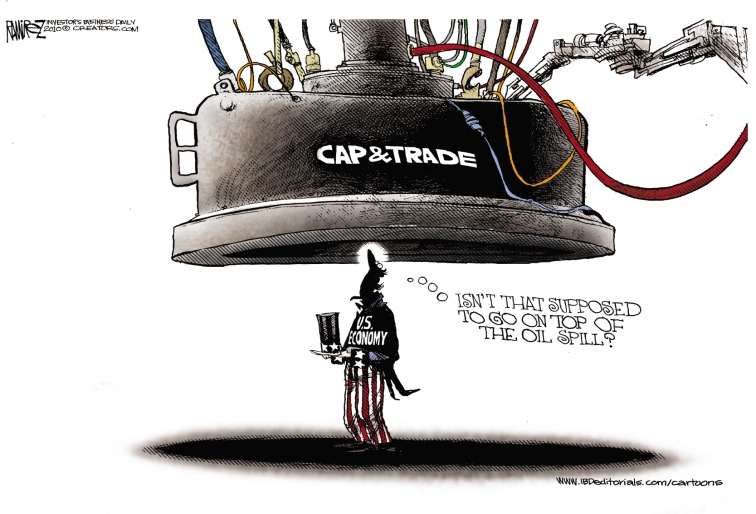
In this week’s Freedom Minute, CFIF’s Renee Giachino lambasts the Obama Administration and Congressional leadership for their shameless exploitation of the oil spill disaster in the Gulf to advance Cap-and-Trade: their devastating plan to send energy prices skyrocketing.
The Beatlemaniacs among us never would have predicted this, but what a refreshing antidote Elton John provides to Paul McCartney.
This month, McCartney put his foot in his mouth and provided even more evidence that John Lennon was the intellectual force behind the Beatles when he slurred President George W. Bush and mindlessly fawned over President Obama. In public comments following his White House performance, and wearing a cheesy Members-Only style 1980s coat, McCartney said, “after the last eight years, it’s great to have a president who knows what a library is” before scurrying offstage. This ignored Bush’s well-known prolific reading habit, and came one day after McCartney admonished reporters to “lay off” Obama.
Brilliant, Paul – the press’s primary job, after all, is to “lay off” the leader of the free world.
But now compare the case of Elton John. This month, Sir Elton famously performed at Rush Limbaugh’s wedding, naturally upsetting the hyper-sensitive liberal chattering class. Then, last night, John performed in Israel in defiance of other performers’ mindless boycott of that isolated nation. He proudly stated that the other musicians’ boycotts “ain’t gonna stop me from playing here, baby,” and added, “we do not cherry-pick our consciences.”
No word yet on whether John will perform alongside Toby Keith at the next Grammy ceremony, but it’s nice to see some sanity among the pop music class.
In an interview with CFIF, Santa Rosa County (FL) Commissioner Gordon Goodin discussed the government’s response to the Deepwater Horizon incident and the severe economic impact on the Gulf Coast.
The Federal Communications Commission (FCC) voted 3-2 along purely partisan lines today to commence federal government micro-regulation of Internet service. In response, Timothy Lee, CFIF’s Vice President of Legal and Public Affairs, issued the following statement:
This spring, a unanimous D.C. Court of Appeals ruled that the FCC doesn’t possess authority to impose so-called ‘Net Neutrality’ over the Internet. In a brazen ploy to circumvent the Court’s ruling, Chairman Genachowski and the FCC today began the process of classifying the Internet as a public utility under laws drafted for Depression-era landline telephones. Their ultimate goal is to overregulate one of the few bright spots of the American economy.
“The Internet sector has prospered over the past two decades precisely because the federal government has refrained from micromanaging it. That ‘hands off’ policy spans both the Clinton and Bush administrations, during which time the Internet has become the most dynamic, innovative and promising sector of our economy and lives.
“That is why almost 250 members of Congress from both parties wrote the FCC admonishing it to refrain from unnecessary overregulation. That’s why a unanimous D.C. Court of Appeals ruled that the FCC doesn’t possess authority to impose so-called ‘Net Neutrality’ over the Internet. And, that’s why the American public opposes ‘Net Neutrality’ by a two-to-one margin.
“Unfortunately, all that means nothing to Chairman Genachowski and those scheming to impose counterproductive and unnecessary regulations on the Internet by any means necessary.
“The FCC’s destructive action will only create regulatory uncertainty, which will discourage private investment, Internet innovation, continued broadband expansion and job growth.
“The Center for Individual Freedom now calls on all Americans to support H.R. 3924, sponsored Representative Marsha Blackburn (R–TN), which will ensure that Congress and the American people determine this matter, not unelected bureaucrats at the FCC.”
Senator Orrin Hatch (R-UT) today introduced two new pieces of legislation to repeal the most troubling provisions of ObamaCare.
“The first, The American Liberty Restoration Act (S. 3502), would repeal the individual mandate that Hatch has repeatedly called unconstitutional and has prompted lawsuits by over 20 states. The second, the American Job Protection Act (S.3501), would repeal the job-killing employer mandate that Hatch says would force more layoffs and increase taxes on businesses at a time of near 10 percent unemployment,” reads a press statement released by the Senator’s office.
On the individual mandate, Senator Hatch said:
Congress overstepped its authority by telling Americans that they have to buy health insurance or else. The Constitution empowers Congress to regulate interstate commerce, but does not tell Americans what they must buy. It’s time to repeal this unconstitutional Washington mandate that encroaches on the principle of federalism and Utahns’ personal liberty.”
On the employer mandate, Hatch noted:
The employer mandate would force businesses to let people go or raise the cost of doing business to such an extent that they don’t start hiring. This doesn’t make any sense at any time, but especially when our nation’s unemployment rate remains stuck around ten percent. Let’s repeal this job-killing provision so businesses can back in the business of hiring.”
It’s time to light up the Capitol switchboard, folks. Both S. 3502 and S.3501 are more than worthy and in need of your support!
When I was a candidate for this office, I laid out a set of principles that would move our country towards energy independence. Last year, the House of Representatives acted on these principles by passing a strong and comprehensive energy and climate bill – a bill that finally makes clean energy the profitable kind of energy for America’s businesses
Now, there are costs associated with this transition. And some believe we can’t afford those costs right now. I say we can’t afford not to change how we produce and use energy – because the long-term costs to our economy, our national security, and our environment are far greater.
Californians need to acknowledge the full consequences of the state’s efforts to reduce greenhouse gas emissions and accept the reality “that the net result of green policies may be negative for the economy,” says a report released today by the California Lutheran University Center for Economic Research and Forecasting…
The report examines economic studies in Europe, where the movement toward green jobs began. It finds the government costs of subsidizing jobs in the renewable energy sector have been excessive.
“In Germany, as in Spain, there is considerable belief that the job creation afforded by investment in renewables has been more than offset by the impact of more expensive energy, which has slowed consumption and investment elsewhere in the economy,” the report says.
In the U.S., it says, “Even as energy prices have increased, the growth of green jobs has been slower than expected. The evidence shows that green jobs and the regulations needed to spur them are expensive and hurt the economy.”
So, Mr. President, how long-term were you thinking exactly?
More on the economic lunacy in my new column reviewing the President’s speech last night.
In response to President Obama’s televised speech from the Oval Office regarding the BP oil spill in the Gulf, below is Pulitzer Prize-winner Michael Ramirez’s latest cartoon.
View more of Michael Ramirez’s cartoons on CFIF’s website here.
Political science purists would quibble with using the term federalism to describe a county government’s ability to declare itself able to act against the wishes of federal and state government…but who cares?
That means the team, led by Public Safety Director Dino Villani, can take whatever action it sees fit to protect the pass without having its plans approved by state or federal authorities.
Commission chairman Wayne Harris said he and his fellow commissioners made their unanimous decision knowing full well they could be prosecuted for it.
“We made the decision legislatively to break the laws if necessary. We will do whatever it takes to protect our county’s waterways and we’re prepared to go to jail to do it,” he said.
Isn’t it instructive to see the relationship between a politician’s decisiveness and his proximity to the people most affected by the spill? Maybe there is something to the idea that any activity that can be performed by a more decentralized entity should be. If anything, the Obama Administration’s hunger for more centralized power over health care, the financial sector, and even the oil spill is showing the limits of so-called “comprehensive” solutions.
According to reporting by Fox News, Faulkner suffers from an incurable kidney ailment that left him wanting to go out with a bang before he died. This from his brother:
“Now that he’s on dialysis he realized that this is going to be his last hurrah,” said Dr. Scott Faulkner, an internist in Fort Morgan, Colo. “One way or the other he knew — if his kidneys failed him, he could die on the mountain, he could take a bullet, or he could get bin Laden.”
Faulkner is trained in the Korean martial art of hapkido, was on his seventh trip to execute America’s #1 enemy, and was armed with a pistol, 40 inch sword and night vision equipment. He’s also savvy enough to get dialysis treatment for his ailing kidneys in between scouting remote forests and mountain ranges.
It’s unclear whether Faulkner will be returned to America or stand trial in Pakistan. Either way, that the Pakistani government would arrest him for doing what it’s failed to do since 2001 seems counterproductive. After all, if a highly motivated foreigner wants to risk his life in Waziristan attempting to kill Pakistan’s – and America’s – most lethal enemy, why not let him die trying? Let’s let Gary be a force multiplier and see if he can at least spook bin Laden out of hiding.
Whom do you trust with the future of broadband? The same federal government that brought us public education, the Post Office and Amtrak?
Or the innovative technology companies that have made the Internet the most vibrant and transformative sector of our modern economy in an atmosphere relatively free from federal overregulation? Public opinion is unequivocal – we trust technology enterprises, not the federal government.
That question nevertheless remains an important one, because Obama’s Federal Communications Commission (FCC) and its far-left cheerleaders continue their effort to impose “Net Neutrality” and set us on a path toward a federal regulatory takeover of the Internet. On Thursday, the FCC will hold an open meeting to”consider possible legal frameworks for broadband Internet services,” which is code for its “Net Neutrality” takeover attempt. On the heels of a unanimous Court of Appeals decision ruling that the FCC doesn’t possess authority to impose “Net Neutrality,” Chairman Genachowski switched to Plan B – simply reclassify Internet service under Depression-era regulations created for 1930s landline telephone service. That scheme contradicts bipartisan consensus spanning both the Clinton and Bush administrations, which is why Democrats and Republicans in Congress sent letters to the FCC objecting to this maneuver.
If successful, the FCC’s backdoor scheme to impose “Net Neutrality” (a dishonest name if there ever was one) will undermine the freedom of technology companies to innovate and invest, which has been the basis of the Internet’s success thus far. Instead of triggering broadband expansion, “Net Neutrality” will only invite years of litigation and acrimony if the FCC presses this agenda.
We simply cannot allow the FCC and federal bureaucracy to do to the Internet what it has done for public education in this country.




 CFIF Freedom Line Blog RSS Feed
 CFIF on X
 CFIF on YouTube