Archive

Posts Tagged ‘energy’
November 16th, 2011 at 5:29 pm
State Department Creates Energy Bureau, Redundancy

The Wall Street Journal reports that Hillary Clinton’s State Department is opening a brand new “Bureau of Energy Resources” today.  Amid the bureaucrat gushing about a “six-fold increase in personnel,” perhaps it’s worth considering just how unnecessary is this new office since its mandate seems to overlap substantially with other agencies.  Here are the “new” duties according to the article:

  • Shore up stable supplies of affordable energy for the U.S.
  • Promote clean energy and changes in markets to make alternative-energy technology more competitive
  • Manage the geopolitics of the energy world
  • Unabashedly support the export of U.S. technology, working with countries to put in a level playing field so U.S. goods can compete internationally
  • Direct the development of the shale gas revolution in the U.S.

If you thought all of these mandates already apply to other entities, you’re right.  Someone should alert the Department of Energy, the U.S. Trade Representative, the Department of the Interior, and the Department of Commerce – as well as a host of smaller outfits known only to the industries they regulate – that yet another federal agency is open and ready to do business harm.

September 16th, 2011 at 3:37 pm
WSJ: Fed Loan Ruined Solyndra

While congressional investigators continue to probe into whether the Obama Administration broke federal laws in awarding a $535 million loan to now-bankrupt Solyndra, the Wall Street Journal details how crony capitalism prolonged a series of bad decisions by the solar company’s management.

Here’s the money paragraph:

In mid-2009, Solyndra had a choice: It could hunker down with its existing factory and try to slash costs to meet competition, drawing on additional private capital as needed, according to the people familiar with the company. Or, with a loan from Uncle Sam, it could gamble and build a brand-new, bigger factory in a bid to gain economies of scale and dominate the market.

Choosing to gamble, Solyndra overbuilt its manufacturing capacity, and continued rushing to market a product that was not marketed – or priced – correctly.

As the WSJ article makes clear, not all of Solyndra’s problems were the result of inept management.  An unexpected drop in the price of a competing product turned Solyndra’s profitability upside down.  The market was sending Solyndra’s management a message to rethink their strategies.  The Obama Administration bypassed that all-important-process with huge amounts of money to continue pursuing failure.

Come to think of it, that pretty much sums up the president’s thinking when it comes to government spending.  No wonder his new jobs plan is dead on arrival.

July 22nd, 2011 at 10:27 am
Podcast: Adam Hasner Discusses Federal Debt Limit, Energy Policy and More
Posted by Print

In an interview with CFIF, Adam Hasner, Former Majority Leader of the Florida House of Representatives and candidate for the U.S. Senate in 2012, discusses the current debt ceiling debate and the need for America to change its policies regarding off-shore drilling, among other issues.

Listen to the interview here.

June 20th, 2011 at 10:51 am
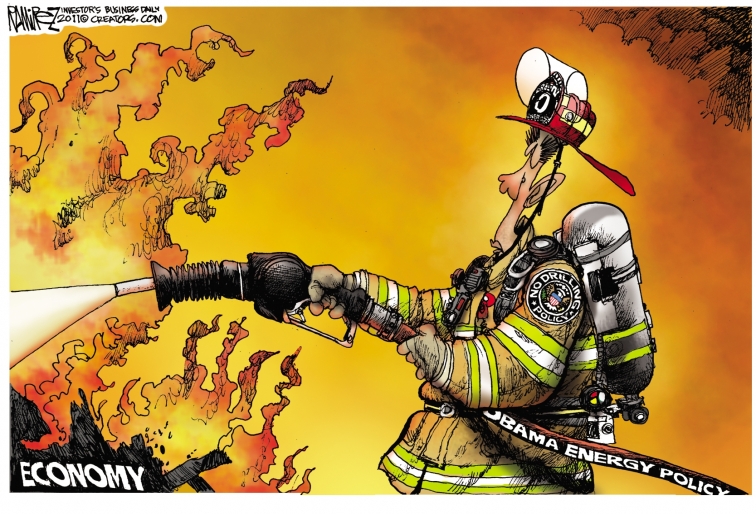
Ramirez Cartoon: The State of U.S. Energy Policy
Posted by Print

Below is one of the latest cartoons from two-time Pulitzer Prize-winner Michael Ramirez.

View more of Michael Ramirez’s cartoons on CFIF’s website here.

May 26th, 2011 at 5:58 pm
Good Ideas from the Obama White House?
Posted by Print

Believe it or not, they occur once in a blue moon. The AP reports:

Oil spill prevention requirements will no longer apply to spilled milk. Gasoline pumps wouldn’t need devices for trapping vapor pollutants, and there would be fewer bureaucratic hurdles for doctors who want to dispense medical advice to a distant patient.

These were among hundreds of existing regulations that the Obama administration said Thursday it wants to revamp or eliminate in a government-wide effort to ease burdens on business. Overall, the drive would save hundreds of millions of dollars annually for companies, governments and individuals and eliminate millions of hours of paperwork while maintaining health and safety protections for Americans, White House officials said.

No jokes. No irony. Just a thanks to the folks at the White House behind this initiative. And a question: can we have some more please?

May 17th, 2011 at 4:40 pm
CFIF to U.S. Senate: Reject New Taxes Targeting Domestic Energy Producers
Posted by Print

As the Senate debates proposed tax rules that would unfairly and discriminatorily target domestic oil and gas producers, the Center for Individual Freedom on behalf of its 300,000 supporters and activists across the United States today formally urged all Senators to vote “NO” on S. 940.   Addressing that counterproductive proposed legislation, Grant Aldonas (former Under Secretary of Commerce for International Trade) and Pamela Olson (former Assistant Treasury Secretary for Tax Policy) warned of its likely destructive consequences in a Washington Examiner opinion piece today.   Here is one particularly relevant excerpt from their commentary:

Rather than offering serious ideas about how to tackle entitlements, cut wasteful spending or reform the tax code, proponents of raising the oil companies’ taxes have seized on the notion that American energy producers benefit from billions of dollars in alleged tax subsidies.

[The] single most damaging thing the proposal does is mortgage our energy future to the state-owned energy giants that now dominate global energy markets. The U.S. economy runs on oil, but we produce only 40 percent of what we consume, meaning our economy and standard of living depend heavily on our access to foreign oil and gas resources.

Reid’s plan works just fine if you are comfortable having America’s energy future decided in Beijing, Moscow, or Tehran. Not so much if you think we should be deciding our own destiny.

Any proposal that would enhance the competitiveness of foreign government-owned oil giants at the U.S. companies’ expense and lead to greater volatility in oil markets and rising prices for U.S. consumers qualifies as a damaging unintended consequence.”  (Emphasis added.)

To read this excellent commentary in full, please click here.

CFIF also urges you to contact your Senators (contact information for your Senators available here) and urge them to vote “NO” on S. 940.

May 3rd, 2011 at 10:33 am
More on Inflation

When I wrote last week on the coming stagflation, I didn’t know that by formerly used official US inflation measures, current inflation is running at 10%. Niall Ferguson says it is. His terrific column is here.

This Ferguson paragraph mirrors one of mine from last week:

To ordinary Americans, however, it’s not the online price of an iPad that matters; it’s prices of food on the shelf and gasoline at the pump. These, after all, are the costs they encounter most frequently. And with average gas prices hitting $3.88 a gallon last week, filling up is now twice as painful as when President Obama took office.

(From my column last week: “The Fed economists may discount food and gasoline prices as unstable indicators that aren’t part of “core” inflation, but for most Americans food and gas cost hikes are the very definition of inflation. These are the things they pay for every day; they are the items closest to their psyches. Those gas prices on the big billboards at every filling station have an outsized effect on American psychology.”)

Here’s the Ferguson bit about how the inflation measure has changed:

And the reason the CPI is losing credibility is that, as economist John Williams tirelessly points out, it’s a bogus index. The way inflation is calculated by the Bureau of Labor Statistics has been “improved” 24 times since 1978. If the old methods were still used, the CPI would actually be 10 percent. Yes, folks, double-digit inflation is back. Pretty soon you’ll be able to figure out the real inflation rate just by moving the decimal point in the core CPI one place to the right.

Good stuff. Read the whole thing.

April 20th, 2011 at 10:03 am
Gulf Blowout Was Terrible Anomaly

Following up on my column today on the execrable Obama response to last year’s Gulf oil spill, it’s worth reading pieces in the New Orleans Times-Picayune today so as to remind us of certain realities. First, as the caption accompanying this editorial notes (and as has been reported numerous times), this disaster hardly came out of nowhere. Instead, workers and mid-level supervisors had been reporting problems on this particular well for weeks.

Both widows including Courtney Kemp, of Jonesville, La. told committee members that their husbands, Shane Roshto and Wyatt Kemp, had told them in the weeks before the explosion about problems they had in controlling the well. “This well was different in the fact that they were having so many problems, and so many things were happening, and it was just kind of out of hand,” said Kemp.

Other reports confirm that these truths:

The AP recently obtained documents showing that a BP drilling engineer who worked closely on the blown-out well kept quiet about his misgivings in the weeks leading up to the accident.

In an email message to his wife on March 11, 2010, Brian Morel said his team aboard the rig was “out of control.”

“I can’t take it, so I am staying away from the issues today,” he wrote.

A few weeks earlier, the company had reprimanded Morel in a performance evaluation, cautioning him to pick his battles and “learn when to push and when to concede.”

In other words, this was eminently preventable. Warning signs were missed. Decision-making was terrible. And BP had a reputation, at least in some quarters, for cutting corners on safety.

What this means is that the risks of something like this happening again are very, very slim. If it hasn’t happened for many decades, and then when it does happen it turns out to have been preventable, and if everybody is now on the lookout for signs of trouble, and if new safety equipment and well-capping equipment has been developed and are ready at hand… well, then, it stands to reason that all other would-be drillers, and all the businesses and individuals who depend on the wells for their livelihoods, should not be punished by a “permitorium” on offshore drilling. Nor should American consumers nationwide, who are seeing energy prices (especially prices at the pump) rise to near-record levels.

Meanwhile, the T-P’s Bob Marshall (who was my boss nearly a quarter-century ago) updates us all on the continuing efforts to analyze the long-term ecological damages from the spill. This is crucial work. Conservatives rightly skeptical of EPA overreach on matters large and small, and property owners justly angry at the federal government’s assault on private property in the name of protecting “wetlands” that are no more than “prairie potholes,” sometimes forget that some ecological causes are indeed important. I have always argued that the most important of those are the health of the oceans and seas and the fisheries within them, which also means protecting the coastal eco-systems (actual wetlands/marshlands) that serve as the nurseries for those fisheries. Hunters and fishermen, innately conservative on so many levels, understand these things.

The trick to protecting these precious resources held in common is not to regulate people half to death, but to provide incentives for (or remove disincentives from) proper husbandry of the wetlands and seas. Government wetlands replenishment projects, to make up for the effects of government levee-building and canal-dredging, also are appropriate in some places — and they are less expensive than are disaster-relief costs to make up for damages caused by hurricanes whose effects would be far less fierce if healthy wetlands were still available to absorb some of the rising floodwaters and otherwise cushion the blow.

Nobody really needs a heavy hand from government; heavy hands too often come down with the force of a Rocky Marciano clenched fist. What is needed is a government that is responsive and smart, one which reacts quickly (Obama’s administration did not) but that does not overreact in ways that further punish the victims (which is what Obama did).

Future blowouts can be prevented without killing the regional or national economies. Again, the BP disaster was an anomaly. As my colleague Renee Giachino said on this site last week, the whole airline industry isn’t closed down when one plane crashes. Why should energy exploration be treated any differently?


April 15th, 2011 at 11:38 am
Video: The Gulf Coast … One Year Later
Posted by Print

One year after the explosion aboard the Deepwater Horizon oil rig in the Gulf of Mexico, CFIF’s Renee Giachino discusses the need for the federal government to stop dragging its feet in allowing truly injured parties on the Gulf Coast to be made whole.  Furthermore, Giachino implores the Obama Administration to stop standing in the way of developing our much-needed oil resources in the Gulf. 

April 8th, 2011 at 7:12 am
Ramirez Cartoon: U.S. Energy Policy
Posted by Print

Two-time Pulitzer Prize-winning cartoonist Michael Ramirez sums up U.S. energy policy under the Obama Administration. 

April 1st, 2011 at 12:02 pm
This Week’s Liberty Update
Posted by Print

Center For Individual Freedom - Liberty Update

This week’s edition of the Liberty Update, CFIF’s weekly e-newsletter, is out. Below is a summary of its contents:

Senik:  Running on Empty with a Full Tank: The Incoherence of Obama’s Energy Policies
Lee:  2012: Electoral Map Tighter Than One Might Assume
Ellis:  Obama’s Proposed Tax Increases Wage War on Civil Society

Freedom Minute Video:  The Case for Conservative Optimism
Podcast:  SCOTUS: The Walmart Suit and Other Pending Cases
Jester’s Courtroom:  It’s a Litigious World After All

Editorial Cartoons:  Latest Cartoons of Michael Ramirez
Quiz:  Question of the Week
Notable Quotes:  Quotes of the Week

If you are not already signed up to receive CFIF’s Liberty Update by e-mail, sign up here.

March 28th, 2011 at 5:09 pm
Federal Regulations Guarantee Higher Gas Prices
Posted by Print

Last week we told you about how President Obama’s steadfast refusal to open up America’s energy resources is keeping prices at the pump artificially high. But as we transition into the summer driving season, it’s important to remember that Obama isn’t the first Washington busybody who wanted to micromanage your gas tank.

Though current oil volatility will mask its effect, decades old federal regulations mandate that gas stations sell a “summer blend” gasoline from June 1 to September 15 (some localities extend the period). The blend is intended to cut down on air pollution in local areas, but it also adds an average of 10 cents per gallon to the cost of gasoline. Just what we needed.

March 25th, 2011 at 9:57 am
Obama’s Domestic Energy Policies Killing Jobs Across America

A damning study that shows the true cost of President Barack Obama’s disastrous domestic energy policies:

The study, “Domestic Vendor Spending Outside the Gulf” found that approximately $1.3 billion of the $1.8 billion in shallow water vendor spending was concentrated in 7 states:

  • Illinois: $376.2 million
  • Pennsylvania: $245.0 million
  • Wisconsin: $176.5 million
  • New York: 139.6 million
  • California: $138.0 million
  • Oklahoma: 125.8 million
  • Alabama: $104.5 million

Here’s what that means in political terms:

Additionally, the survey found a nationwide economic impact. Shallow water expenditures were made in 219 congressional districts — including 102 congressional districts with expenditures of $1 million or more, 32 congressional districts with expenditures of $10 million or more and 7 congressional districts with expenditures of $75 million or more.

Refusing to issue new permits for deep and shallow water drilling only increases the costs of gasoline and natural gas to consumers and destroys jobs across America.  Along with financial boondoggles like ObamaCare, the president’s willful refusal to increase domestic energy supplies is likely to be a huge liability in his reelection bid.

March 21st, 2011 at 9:48 pm
Obama Comes Out in Favor of Oil Exploration … in Brazil
Posted by Print

As developments in the Middle East and a wayward monetary policy send gas prices consistently north, President Obama — no friend of hydrocarbons he — seems to be turning over a new leaf on the topic of oil exploration. The only problem? He wants other countries to do the heavy lifting so that we can then import the black gold. An editorial in today’s Investor’s Business Daily has the POTUS dead to rights:

Now, with a seven-year offshore drilling ban in effect off of both coasts, on Alaska’s continental shelf and in much of the Gulf of Mexico — and a de facto moratorium covering the rest — Obama tells the Brazilians:

“We want to help you with the technology and support to develop these oil reserves safely. And when you’re ready to start selling, we want to be one of your best customers.”

Obama wants to develop Brazilian offshore oil to help the Brazilian economy create jobs for Brazilian workers while Americans are left unemployed in the face of skyrocketing energy prices by an administration that despises fossil fuels as a threat to the environment and wants to increase our dependency on foreign oil.

Despite some of the more emotional pleas for energy independence, there’s nothing inherently wrong with importing fuel from foreign sources. In fact, developing new oil production anywhere lowers the price everywhere. However, someone might want to tell President Obama that this maxim applies to U.S. sources as well.

March 18th, 2011 at 10:02 am
Video: The Obama Gas Tax
Posted by Print

In this week’s Freedom Minute, CFIF’s Renee Giachino explains how President Obama’s energy policy – namely, his opposition to opening up America’s vast domestic resources – amounts to a massive energy tax at a time when prices at the pump are soaring ever higher.


March 15th, 2011 at 11:12 am
Ramirez Cartoon: The Obama Energy Plan
Posted by Print

Below is one of the latest cartoons from two-time Pulitzer Prize-winner Michael Ramirez.

View more of Michael Ramirez’s cartoons on CFIF’s website here.

March 14th, 2011 at 12:53 pm
Unions, Environmentalists at War over EPA Regulations

Since at least the FDR era, the Democratic Party has served as an umbrella for a motley coalition of special interest groups that have only one thing in common: demanding action from government.  Most of the time, the competing priorities of the groups don’t come into direct conflict.  But when they do, it is a delight to sit back and watch each carve up the other.

Today’s example comes from the pages of the Wall Street Journal.  Apparently, businesses in the energy sector aren’t the only ones fighting the Obama Administration’s job-killing EPA regulations.  Labor unions like the Utility Workers Union of America and the United Mine Workers are demanding a ceasefire on cap-it-or-close-it regulations that could force companies to close 18% of the nation’s coal factories if they fail to comply with the EPA’s proposed climate change rules.

Unions recognize that without factories workers get fired.  Environmentalists don’t want to budge on what the Natural Resources Defense Council calls “the biggest public health achievement” of the Obama Administration.

Simple math is likely to break the stalemate.  Unions in coal states account for millions of campaign contributions and thousands of votes.  With Ohio, Pennsylvania, Michigan and Wisconsin all flipping from Obama in 2008 to the Republicans in 2010, don’t count on the president to sacrifice his reelection chances on the altar of green jobs.

If he does, union voters – and their dollars – just might stay home in 2012.

March 11th, 2011 at 12:22 pm
Soaring Gas Prices Inspire Republicans to Invest, Democrats to Spend

As if we needed another issue to highlight the differences between conservatives and liberals, the skyrocketing price of gasoline is showing each side’s true colors.

Fox News reports that House Speaker John Boehner (R-OH) wants to put forward several ‘bite-sized’ bills to expand domestic energy production through increased oil drilling, easier permitting, and promoting nuclear power plant construction.  (The piecemeal legislation is also intended to be a jab at Democrats’ penchant for ‘comprehensive’ legislative fixes.)

Liberals like Ed Markey (D-MA) want to tap into the Strategic Petroleum Reserve to drop prices by increasing supply.

How brazenly foolish.  As usual, liberals want to blow a savings account instead of increasing their revenue streams.  Shattering the nation’s energy piggy bank isn’t a solution to the problem – it’s a delaying tactic that puts off the hard decisions until later.

The time for stop-gap measures is over.  If liberals continue to show a genetic inability to create sustainable budget and energy policies, conservatives should bypass them and get America back on a sound footing.

March 9th, 2011 at 1:01 pm
Ramirez Cartoon: Obama’s Energy Policy
Posted by Print

Below is one of the latest cartoons from two-time Pulitzer Prize-winner Michael Ramirez.

View more of Michael Ramirez’s cartoons on CFIF’s website here.

November 23rd, 2010 at 10:01 pm
The Only Problem with Green Jobs is that they Don’t Exist
Posted by Print

Senik’s Law of Subsidies: Subsidizing any industry into existence requires destroying its more efficient competitors. And that, ladies and gentlemen, is the story of green jobs.

Luckily, the Obama Administration hasn’t been able to get its hands on the noose with which it intends to strangle the energy industry (I’m sorry … the industry that produces energy that actually works): that would be cap and trade. Thus, it’s had to settle for the silver medal of plowing money into “green jobs” that can’t balance the books without a chunk of your paycheck to stem the tide of red ink. The problem, of course, is that since conventional fuel sources like coal and petroleum are still the most feasible energy sources, the government is underwriting jobs that serve no discernible demand in the consumer market. Consider this passage from a story in today’s Washington Post:

With nearly 15 million Americans out of work and the unemployment rate hovering above 9 percent for 18 consecutive months, policymakers desperate to stoke job creation have bet heavily on green energy. The Obama administration channeled more than $90 billion from the $814 billion economic stimulus bill into clean energy technology, confident that the investment would grow into the economy’s next big thing.

What could go wrong? After all, if the administration is “confident”, there’s no reason to doubt, right? The Obama White House is know for nothing if not its clairvoyance (we’ll leave aside the question of why the “next big thing” would require subsidies). Oh, Mr. President, we hate to interrupt your dance with delusion, but reality would like to cut in:

The industry’s growth has been undercut by the simple economic fact that fossil fuels remain cheaper than renewables. Both Obama administration officials and green energy executives say that the business needs not just government incentives, but also rules and regulations that force people and business to turn to renewable energy.

Without government mandates dictating how much renewable energy utilities must use to generate electricity, or placing a price on the polluting carbon emitted by fossil fuels, they say, green energy cannot begin to reach its job creation potential.

Forget Afghanistan. Energy policy is the administration’s real parallel to Vietnam. We must destroy our energy sources in order to save them.