August 13th, 2012 at 2:05 pm
Bobby Jindal Explains Paul Ryan’s Medicare Plan
Posted by Print

Especially starting at about the 5-minute mark of this clip, Bobby Jindal destroys the attacks against Paul Ryan’s Medicare plan. He was being by Chuck Todd, who leans a bit left but who is one of the most fair-minded and thorough of establishment-media reporters/analysts. Todd pressed the accusation that the Ryan “premium support” plan would favor the rich over the poor. Jindal blew away that charge, reminding Todd (and informing viewers) that the federal subsidy known as premium support would be income-adjusted. He also reminded people that the premium support idea has strong bipartisan provenance. Good stuff.


August 13th, 2012 at 12:54 pm
Ryan Saving Private
Posted by Print

Paul Ryan is all about saving the private sector form the ravages of government. Paul Ryan is all about opportunity. He is all about economic growth. And he is all about a can-do, take-charge attitude that is perfectly in keeping with the American character.

The choice of Ryan was superb. Now the Romney campaign must match its strategy and tactics to the bold nature of this choice.

The last time I felt this good about a ticket was about Ronald Reagan. Say “Romney-Ryan” real fast and it even sounds the same.

Tags: , ,

August 13th, 2012 at 12:17 pm
The Ryan Pick
Posted by Print

Count me pleasantly surprised by Saturday’s announcement that Mitt Romney has selected Paul Ryan as his running mate. Given the risk-averse nature the Romney campaign had demonstrated up to this point, I was expecting the choice to be bland and uninspiring — my foremost guesses having been Rob Portman or Tim Pawlenty (for what it’s worth, multiple reports seem to indicate that Romney’s final choice came down to those two and Ryan). Ryan, who truly has been the intellectual leader of the Republican Party for the past several years, is a vastly superior choice to either of those two.

I have no idea how the politics of this play out. It seems to me that the fears that liberal demagoguery of the Ryan budget could cost Romney Florida are well-founded, given the state’s huge population of seniors. Minus the Sunshine State, it’s hard to envision a scenario where Romney becomes the 45th President of the United States in January. I also remain skeptical that, even with Ryan on the ticket, Wisconsin will elude Obama’s grasp this time (I hope I’m wrong about this, but it seems to me that the conservative commentariat has been excessively enthusiastic about prospects for flipping the Badger State ever since the Scott Walker recall).

These are not causes for despair necessarily, but cautionary notes as we begin the campaign in earnest after Labor Day. The Romney campaign — not known heretofore for its exceptional messaging skills — has just given itself perhaps the most daunting communications task in the history of modern American presidential elections. This election will no longer be a backwards-looking discussion about Barack Obama’s stewardship of the American economy over the past four years; instead it will be a 90-day symposium about what the “social contract” (a phrase I loathe, but one that will carry the day) will look like in 21st Century America.

The advantage that Romney and Ryan have is that their vision — reining in spending, empowering individuals, reducing the debt, and reasserting individual responsibility — is the only one that is viable in the long-term. The advantage that Obama and Biden have is that their vision — an unsustainable status quo that cossets Americans from responsibility and hides the calamitous costs of the welfare state — is much less psychologically disruptive, a trait that (sadly) goes a long way in winning over a substantial portion of the electorate.

The stakes of this election have just become enormous. This is no longer about whether Mitt Romney will become president or not. It’s now about whether the conservative vision for arresting America’s decline will receive popular ratification. And there are only 12 weeks to make the case. With the smartest, most articulate defender of the conservative alternative now on the ticket, we’re about to run out of excuses. If we can’t win this time, the resultant chaos will make the aftermath of the 2008 election look like a garden party.


August 11th, 2012 at 9:40 am
Romney Picks Ryan
Posted by Print

Governor Mitt Romney this morning announced his choice of Representative Paul Ryan (R-WI) as his Vice Presidential running mate.  It is a great pick.

There is no other public official on the planet who can better articulate conservative economic principles to the electorate – and aggressively advocate those principles to address our nation’s fiscal crisis head on – than Paul Ryan.   He is a man of strong character and deep intellect.  He is unapologetic in his defense of individual liberty and free enterprise.  And he knows that America is an exceptional nation.

Most important, Romney’s choice of Paul Ryan shows that his priority is leading and governing the nation.

Game on!


August 10th, 2012 at 2:26 pm
Final* Veep Chances
Posted by Print

This is my FINAL assessment of the percentage chances of each potential Romney running mate of actually getting chosen. Something is telling me that Rob Portman is out of the picture. I’ve never thought Rubio had much chance. Nobody has seemed to listen to my arguments in favor of Kyl, Toomey or Santorum. And I think Kelly Ayotte got a very close look, deservedly so, but probably I think she faded just from lack of national seasoning.

Jindal 19%

Ryan 19%

Pawlenty 19%

Christie 19%

McDonnell 19%

Anybody else 5%

* The only way this will not be my final assessment is if I get a very, very reliable “scoop.”


August 10th, 2012 at 12:52 pm
American Airlines’ Labor Union Antics Continue
Posted by Print

In yet another example of big labor flexing its destructive muscle to undercut American Airlines’ bankruptcy restructuring, the Allied Pilots Association this week rejected a contract offer from American that included pay raises and a 13.5 percent stake in the company, among other generous terms. 

To make matters worse, afterwards, the union board forced its president David Bates – who has a reputation for being both reasonable and pragmatic – to resign as seemingly a sole consequence of his support for American’s offer. 

It’s now beyond clear that the pilots union is going all in with US Airways CEO Doug Parker, who has made numerous promises to labor in his recent attempts to prematurely force a merger with American. This is the same CEO Parker who, since uniting America West with US Airways seven years ago,  has been unable to settle terms with the pilots of those airlines, even while he is now actively negotiating with American’s pilots. 

The fact remains that the entire airline industry was bloated during the last decade, and every legacy carrier has been forced to restructure to reduce their costs. While American – whose onerous labor costs are the highest in the industry – waited the longest to restructure, the company has recently excelled financially. To sustain its recent performance, however, there is no getting around the fact that it will need  to continue to cut costs, which means labor will have to agree to reasonable concessions.

Fortunately, a number of other unions have been more agreeable in their negotiations with American: mechanics and aircraft stock clerks represented by  the Transport Workers Union both ratified new accords this week. 

But if American’s pilots are unable to cooperate with their own labor leadership, colleagues and management to accept generous but realistic contract terms, they could effectively send their employer, or perhaps the entire airline industry, the way of the auto industry.

The difference this time being, the taxpayers won’t be there to bail them out.


August 10th, 2012 at 12:39 pm
Romney Should be Worried, But Not Panicked
Posted by Print

So says Nate Silver, in this bit of superb analysis.

Also via Silver, Bob McDonnell gets a huge boost, and Tim Pawlenty a HUGE downer, from this analysis. (I discount the Portman boost also in here, because this measures ONLY home-state effects of the Veep choice. My contention is that Portman helps at home, but hurts EVERYwhere else, at least a little, because of the combo of his multiple Bush ties and because of his wealthy son of wealthy son status. For that matter, I also give bonus points to Christie and Jindal for NON-home-state effects: I think Christie helps across the Rust Belt on style points alone — and perhaps especially in Pennsylvania, because it shares some media markets with New Jersey, plus can take the fight to Obama in what has turned into the vilest, most vicious race in history — while Jindal helps thematically by allowing Romney to better make the election a referendum on ObamaCare, because Jindal can offer and explain positive alternatives to it.)

The other guy who I’ve touted all along among my top five picks is Pat Toomey. It baffles me that he hasn’t gotten more attention. Silver’s analysis (see his very last chart) shows Toomey quite high among all the possibilities in terms of the actual likelihood that his choice alone could swing the election. He also risks almost no down-side, and his balanced-budget plan doesn’t risk anything that could be demagogued as “slashing” Social Security and Medicare.

Food for thought!


August 10th, 2012 at 10:30 am
This Week’s Liberty Update
Posted by Print

Center For Individual Freedom - Liberty Update

This week’s edition of the Liberty Update, CFIF’s weekly e-newsletter, is out. Below is a summary of its contents:

Hillyer:  The Sleaziest Campaign of All?
Ellis:  Government Gone Insane
Senik:  California: First in Liberalism, Last in Everything Else
Release:  CFIF Launches Enhanced State Sovereignty Project

Editorial Cartoons:  Latest Cartoons of Michael Ramirez
Jester’s Courtroom:  Dissecting this Lawsuit against a Hospital
Quiz:  Question of the Week
Notable Quotes:  Quotes of the Week

If you are not already signed up to receive CFIF’s Liberty Update by e-mail, sign up here.


August 10th, 2012 at 8:58 am
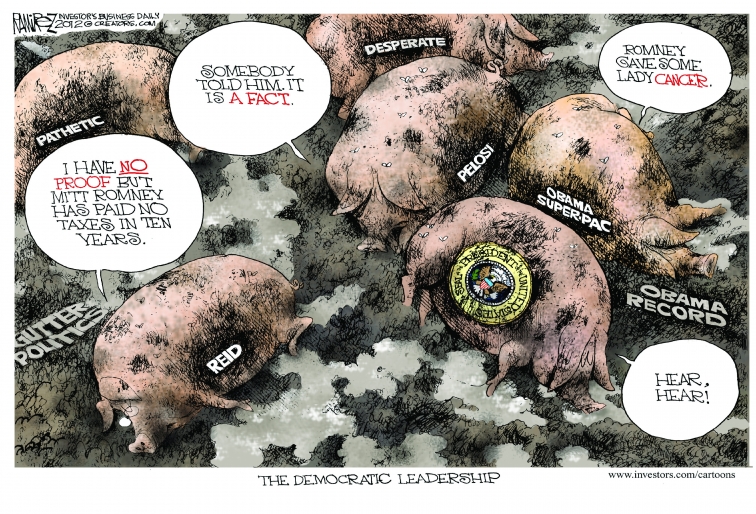
Ramirez Cartoon: The Democratic Leadership
Posted by Print

Below is one of the latest cartoons from two-time Pulitzer Prize-winner Michael Ramirez.

View more of Michael Ramirez’s cartoons on CFIF’s website here.


August 9th, 2012 at 5:38 pm
Donald Trump Provides Econ 101 Lesson … In 140 Characters or Less
Posted by Print

Early this week, the liberal group Americans United for Change and the American Federation of State, County and Municipal Employees launched a $280,000 ad campaign targeting some Republicans who voted to extend all of the Bush tax cuts for all Americans.  The ad charges them with voting “to give people like Donald Trump a tax break worth $150,000 a year…” [Emphasis added]

In response, the Donald took to Twitter and fired back with the following:

To the geniuses at ‘Americans United for Change’: the more you tax me the less people I employ. Get it?

That’s the problem, Mr. Trump.  They don’t get it.


August 9th, 2012 at 3:49 pm
Podcast: Congresswoman Discusses ObamaCare, Unemployment and Taxes
Posted by Print

In an interview with CFIF, Congresswoman Nan Hayworth, M.D. (NY-19), the only female physician serving in Congress, discusses why repealing and replacing ObamaCare will provide immediate relief for millions of Americans who are desperate to find jobs and the need for a flatter, fairer and simpler tax code to relieve burdens on small business owners and employers, strengthen the economy and grow jobs.

Listen to the interview here.


August 9th, 2012 at 3:09 pm
An ObamaCare Exchange By Any Other Name…
Posted by Print

God bless residents of the Pacific Northwest for casting rightful suspicion on ObamaCare’s state-based, federally-directed, health insurance exchanges:

Focus groups in Oregon expressed emotions about buying coverage that included “skepticism” and “frustration,” and some individuals and small businesses used “black hole” and other less-kind terms to refer to insurance, brand design firm Sandstrom Partners told the Oregon Health Insurance Exchange in a presentation made available by the exchange.

The word exchange “raises some suspicions of loopholes and fine print” and “implies current coverage may needed to be traded for something else,” wrote communications company GMMB in a presentation to the Washington State Health Benefit Exchange. Part of the problem, GMMB said, was that the word was “perceived as a verb and unfamiliar as a noun” and reminded people of the New York Stock Exchange or military exchange stores.

Washington state is leaning toward calling its program Washington HealthLink, as long as it doesn’t conflict with existing trademarks, and plans to use green and blue in its logo design because the colors are considered to be reassuring, said Michael Marchand, the state’s exchange director. The exchange’s board of directors will make the final decision on the name, he said.

Focus group participants had also been asked to consider HealthChoice but it “makes some wonder if Washington State is making the choice for them,” consultants and the exchange board concluded.

The Wall Street Journal article from which these excerpts are culled goes on to detail other stories of states trying to brand government-created “marketplaces” as something other than a first big step to government-run health care, but you get the point.

No matter what you call an ObamaCare exchange, it’s still an entry point for socialized medicine.


August 9th, 2012 at 2:16 pm
Media Ignore Vile Ad
Posted by Print

With regard to my column this morning, Newsbusters helps make my case. Blogging for the WashPost, Jennifer Rubin also hits the “good government” moral thermometers who suddenly can’t be found. Media cretins make me sick.

Tags:

August 9th, 2012 at 1:51 pm
Barack Obama, Journalism Critic
Posted by Print

A piece by Amy Chozick in the New York Times this week has to be read to be believed (ok, you’ll read it and you still won’t believe it). Proving that there is absolutely nothing for the media to do in August, Chozick was commissioned to write a piece on President Obama’s relationship with the press, including the Commander-in-Chief’s critical exegesis of the fourth estate. The results are predictably hilarious:

The news media have played a crucial role in Mr. Obama’s career, helping to make him a national star not long after he had been an anonymous state legislator. As president, however, he has come to believe the news media have had a role in frustrating his ambitions to change the terms of the country’s political discussion. He particularly believes that Democrats do not receive enough credit for their willingness to accept cuts in Medicare and Social Security, while Republicans oppose almost any tax increase to reduce the deficit.

Privately and publicly, Mr. Obama has articulated what he sees as two overarching problems: coverage that focuses on political winners and losers rather than substance; and a “false balance,” in which two opposing sides are given equal weight regardless of the facts.

Mr. Obama’s assessments overlap with common critiques from academics and journalism pundits, but when coming from a sitting president the appraisal is hardly objective, the experts say.

Basically, you can close your eyes, point to any sentence at random, and prepare to guffaw.

There’s a lot of awfully stupid analysis here (both the Times and Obama’s). Maybe one of the reasons, for instance, that Democrats’ supposed willingness to rein in entitlements goes unpraised is because there have been some tells that it’s less than sincere — like the occasional fit of the vapors that finds liberals essentially accusing Paul Ryan of going from hospital to hospital unplugging life support machines.

There’s also the Times’ eager embrace of the unquestioned wisdom of (unnamed) “academics and journalism pundits” (FYI, that last one’s not a real job), a not-too-subtle hint that Obama’s frustration, poor soul, is shared by Really Smart People everywhere.

The aspect that I find most telling, however, is the president’s frustration with “false balance,” which it’s hard to interpret any other way than an irritation that the press doesn’t accept his side of the argument as gospel. This is of a piece with what he told the American Society of News Editors at a speech back in April:

“As all of you are doing your reporting, I think it’s important to remember that the positions that I am taking now on the budget and a host of other issues — if we had been having this discussion 20 years ago or even 15 years ago — would’ve been considered squarely centrist positions,” he said in response to a question about Republicans’ criticisms of his spending priorities. “What’s changed is the center of the Republican party and that’s certainly true with the budget.”

“This bears on your reporting,” he said Tuesday. “I think that there is oftentimes the impulse to suggest that if the two parties are disagreeing, then they’re equally at fault and the truth lies somewhere in the middle. And an equivalence is presented, which I think reinforces peoples’ cynicism about Washington in general. This is not one of those situations where there’s an equivalency.”

For what it’s worth, I actually agree with Obama on “the truth lies in the middle” trope. There are occasions when that’s true, but most times that you hear someone express that sentiment it’s a sign that they’ve put their brain on cruise control and resigned themselves to communicating exclusively through cliches. What’s the midpoint between the death penalty being legal or illegal? What’s the midpoint between going to war with Iran or not going to war with Iran? No one actually lives by “moderation in all things” (“So it’s okay if I just participate in occasional arson?”), but everyone talks that way. That mindset creates especially acute problems in public policy, where splitting the baby almost always yields bad results.

There are two problems, though, with Obama’s analysis. The first is that the only corrective for “false equivalence” is a more ideological press, which presents issues from unapologetic (and admitted) liberal and conservative viewpoints. That’s where we are today and, while there’s plenty of chaff as a result, I’m inclined to think it’s far preferable to an overwhelmingly liberal media trying to create the illusion of objectivity. But that’s not what Obama wants. He’s clearly longing for the days when ‘media’ was a de facto singular noun and those who disagreed with him would have been pilloried as unreasonable without much push back.

The second problem is that Obama himself ascended to office on the basis of little more than ‘false equivalance’. If you’d like to give your brain the equivalent of diabetic shock, go back and read his treacly 2006 best-seller, “The Audacity of Hope,” where nearly every issue discussed is framed with a “on-the-one-hand, on-the-other-hand” device (he’s sandbagging you, of course — every question is resolved, ostensibly by inches, in favor of liberalism.)

So do I think Barack Obama knows bad writing? Yes. Because he’s practiced it.


August 9th, 2012 at 1:17 pm
Great Piece on Vote Fraud
Posted by Print

In the New York Post. Read it here.

Tags:

August 8th, 2012 at 7:32 pm
President’s ObamaCare Deception
Posted by Print

Politico reports that in a campaign speech in Colorado today President Barack Obama framed his Patient Protection and Affordable Care Act (aka ObamaCare) this way:

“Let me tell you something, Denver, I don’t think your boss should get to control the health care that you get,” Obama told the crowd at a campaign stop in Colorado. “I don’t think insurance companies should control the care that you get. I don’t think politicians should control the care that you get. I think there’s one person to make these decisions on health care and that is you.”

What the President neglected to mention is that instead of employers, insurance companies, and politicians – and despite his comments about individuals – the constituency he really favors making health care decisions is the federal bureaucracy.

ObamaCare’s Medicaid expansion is intended to capture millions of Americans newly eligible for government coverage that will be – at least initially – cheaper than their current private provider.  The state-based, but federally-directed, health care exchanges are really just Trojan horse structures allowing HHS to seize control of the states’ traditional role in regulating health insurance whenever a state defies a federal prerogative.

And let’s not forget that the Independent Payment Advisory Board is empowered to act as a backdoor ration board, setting price caps on medical reimbursements that will distort the market and cause shortages.  In socialized systems like Britain and Canada long waiting times are the norm, as are denials of procedures in favor of pain management.

All of these elements – Medicaid expansion, federally managed health exchanges, and IPAB – empower one group: unelected, unaccountable bureaucrats.  To claim as the President does that private individuals will be the ones calling the shots on health care decisions is either foolish or deceptive, and I don’t think the man is lacking in smarts.


August 8th, 2012 at 4:00 pm
Senator Rand Paul Proclaims the Need to Protect Intellectual Property
Posted by Print

“I do believe in intellectual property. I do believe you have a right to your property.”

So said Senator Rand Paul (R-KY) in response to a question following his remarks during an event last week at the Heritage Foundation titled, “Will the Real Internet Freedom Please Stand Up?

In Article I, Section 8 of the U.S. Constitution, our nation’s Founders specifically provided for the protection of intellectual property (IP) in order “To promote the Progress of Science and useful Arts.”  While the fundamental concept of providing artisans, authors and inventors exclusive right to their respective works and discoveries has remained relatively uncontroversial for most of the nation’s history, recent debates regarding what to do about widespread infringement over the Internet have caused some to diminish IP protection by setting it aside as merely some abstract, disposable ideal.

That mindset is dangerous, both in theory and in practice.

First and foremost, intellectual property is vital to free enterprise and drives economic growth. According to a recent study by the Global Intellectual Property Center, IP-intensive industries currently employ more than 55 million Americans and account for 74% of all U.S. exports and $5.8 trillion in GDP.  Without strong IP protections, the incentive to innovate is removed, drying up investment, stalling growth and progress, and thus undercutting the entire economy.

Little if any incentive would exist for an author to write the next great novel, Hollywood to produce the next cinema blockbuster or a pharmaceutical company to develop a cure for cancer if none of them are able to benefit economically from their works.

Moreover, when the importance of IP is diminished or dismissed altogether, its protection is afforded different levels of enforcement not on par with that of physical property.  But the concept of property should not be rooted in its physical existence.  Owning property is a contract that provides the title-holder specific rights that lead to economic benefits, not simply a plot of land. In that way, intellectual property is no different than any other form of property. 

Senator Paul gets it. In his remarks – previewed as “what could be the most significant talk on Internet freedom this year” by the Heritage Foundation’s Robert Bluey – Paul declared, “There are some libertarians who don’t believe in copyright. I am not one of them. I think you have to protect intellectual property.”

Senator Paul’s comments reveal that not only do some libertarians get IP wrong, but that all property needs protection and enforcement thereof. As evidenced by over 200 years of practice, patent, trademark and copyright protections promote the general welfare and lead to great economic advantages by driving innovation and developing capital. The end result comes in the form of countless benefits from millions of IP-intensive jobs, billions in exports and trillions in GDP spilling over to the rest of society.

Property, including intellectual property, is preeminent and deserves strong protections.


August 8th, 2012 at 1:36 pm
Bloomberg: Obama Can Win Sweeping Victory by Raising Everyone’s Taxes
Posted by Print

Yes, you read that right. New York City Mayor Michael Bloomberg (who, let’s be honest, is the most irritating politician in America) has an ingenious campaign strategy for Barack Obama that’s totally going to spellbind the room at his next cocktail and caviar soiree. From a phone interview Bloomberg gave to the Huffington Post:

“What Obama should do is say he’s going to veto any change to the end of the expiration of the Bush era tax cuts for everybody, and I feel very strongly about the everybody because you don’t want to split the country — that’s not what America is all about,” said Bloomberg.

“Obama would win this election going away if he’d stand up and say, ‘I’m gonna do this,’ and then turn to Republicans and say, ‘You know, you didn’t want any more revenues … I just outfoxed you. Now work with me on cutting expenses, and we’ll actually balance the budget in 10 years, and we’ll do it responsibly.'”

Bloomberg here reminds me a bit of Walter Mondale, who thought it was utter genius to declare in his 1984 acceptance speech at the Democratic Convention that he would raise taxes (Newt Gingrich, who was part of a Republican rapid response team during that convention, has noted that his group decided to pack up and go home after Mondale’s declaration, figuring they couldn’t damage him any worse than he had himself). Mondale’s theory was that both he and Reagan would end up hiking taxes, but that voters would give him points for being honest about it (for a thorough understanding of the truth of Reagan’s tax record, by the way, this Matt Lewis piece is indispensable). Later, after losing 49 states in the Electoral College, he probably thought better of that.

Here’s the foundational error in both cases: the tax argument is about substance, not style. Mondale thought he’d be rewarded for being honest about the fact that he was going to take more money away from the American people. But we don’t generally reward honesty when it’s a truthful admission of nefarious intent. Similarly, Bloomberg seems to think that “unity” is more important than tax rates, and that the American people will reward Obama if he makes clear that he’s going to put the screws to all of them with equal force. But, to paraphrase Obama from 2008, no one much cares what shade of lipstick you apply to a pig. The equal distribution of suffering is not a compelling campaign rationale (although it might be the most honest slogan Obama could devise).

There’s another irony at work here, of course: if Bloomberg thinks that tax rates should be harmonized in order to avoid “splitting the country,” the most logical step he could take would be to promote a flat tax. But that probably wouldn’t fly at the open-bar receptions of the Upper East Side.


August 7th, 2012 at 7:08 pm
Why Romney Won’t Pick SC’s Nikki Haley for VP
Posted by Print

Besides her Sarah Palin-esque rise to prominence as South Carolina’s Governor – and the fear that she’s too green to be Romney’s vice president – there’s another, more salient reason Nikki Haley isn’t being talked about as Mitt’s running mate: she’s using Barack Obama’s stimulus formula and getting worse results.

According to The Daily Caller, since becoming governor in 2011, Haley has tried to dole out more than $70 million in tax incentives and grants to businesses as a way to create jobs in South Carolina.  Still, the state’s unemployment rate sits at 9.1 percent, much higher than the 8.3 percent national average.

Some Palmetto State conservatives have had enough, including Harry Kibler, a Tea Party member and founder of RINO [Republican In Name Only] Hunt:

“She basically is running all over the state trying to make sweetheart deals with corporations to entice them to move to South Carolina and start business here,” said Harry Kibler, a tea party activist and founder of the conservative group RINO Hunt.

“I have a heartfelt philosophy that if we get government intrusion out of the business culture in South Carolina, that business will move here on its own,” Kibler told The Daily Caller News Foundation.

“The governor seems to think that the only people in South Carolina that create jobs is the state legislature and the government,” RINO Hunt’s Kibler countered. “Make South Carolina the freest state or the cheapest state to do business — for all business — and business will naturally be attracted to South Carolina.”

Don’t expect Mitt Romney to invite that kind of criticism from the Right by picking Nikki Haley as his vice president.


August 7th, 2012 at 4:13 pm
The High School of the Future, Now
Posted by Print

Check out a fascinating new public school in Salt Lake City called Innovations High School.  A first-of-its-kind program, Innovations allows public school students to sample every type of educational model currently available.  According to a story in the Salt Lake Tribune, kids in grades 9 – 12 can blend online and in-classroom learning, choosing courses in traditional subjects as well as technical programs from community colleges.

The purpose of Innovations is to give students and their parents more flexibility when it comes to progressing through coursework.  The personalized nature of the Innovations experience also lets kids get exposure to well-paying career options they might otherwise miss in a more structured high school program.

I apologize if my summary sounds like a paid advertisement –it isn’t – but the flexibility seemingly provided by an Innovations education makes too much sense to be ignored.  Too many kids aren’t allowed to fit their education around their interests and abilities.  The result is often a one-size-fits-all widget system that pumps out graduates who know a little (or in many cases very little) about many things, but have no depth or experience in anything.

It should be noted that Innovations is not a charter school.  Rather, it’s a project by school administrators to use the changes wrought on education by technology to create new opportunities for local students currently in public, private, and home school situations.  If quality and flexibility are the norm, then Innovations might represent one area where traditional public schools can entice high-performing students back onto campus.

H/T: Governing.com