Archive

Posts Tagged ‘Obamacare’
June 6th, 2012 at 4:56 pm
Another ObamaCare “You Can Keep Your Insurance” Casualty: College Health Plans
Posted by Print

Remember when Obama  solemnly and repeatedly promised that “if you like your insurance plan, your doctor, or both, you will be able to keep them?”

If not, don’t beat yourself up.  He has broken so many promises that no reasonable person can keep tally.

But score another casualty to ObamaCare specifically.  According to The Wall Street Journal, college students should expect their plans to become more expensive or disappear altogether:

“Some colleges are dropping student-health plans for the coming academic year and others are telling students to expect sharp premium increases because of a provision in the federal health law requiring plans to beef up coverage.  The demise of low-cost, low-benefit health plans for students is a consequence of the 2010 health care overhaul.  The law is intended to expand coverage to tens of millions of uninsured Americans, but it is also eliminating some insurance options.”

Moreover, that consequence will likely be widespread:

“The new rules are likely to affect a broad swath of American colleges.  Some 60% of schools’ plans had coverage of $50,000 or less for specific conditions, and almost all of the rest have some sort of payout caps that they will have to do away with by 2014, the GAO study found.”

And the Obama Administration’s response?  They apparently couldn’t care a whole lot less.  “The Obama Administration,” the report notes, “argues that the most limited benefit plans colleges previously offered hardly counted as coverage at all.”

Yeah, that should motivate the youth vote for Obama just like those vapid, naive days of 2008.

May 21st, 2012 at 4:45 pm
Today We Are All Catholics

With today’s filing of lawsuits (against ObamaCare’s abortifacient mandate) in 12 federal districts by 40 different Catholic organizations, the issue is now squarely at hand: Are Americans allowed free consciences and free exercise of religion, or not? The Obama administration, its tyrannical impulses(and fundamental lawlessness alien to the American tradition) now available for all to see, says no. These 40 Catholic entitities — supported even before their suits by statements of support from many other denominations — say yes, we are free people with free consciences and the right to freely exercise our religion.

At NRO today, the great George Weigel explains it all better than I’ve seen anywhere else:

As the battle continues, it will be important, amidst the litigators’ argument and the administration’s attempts to reply, to remember that what is at stake here is nothing less than the future of civil society in the United States.

A victory in the lawsuits filed against the administration’s mandate will be more than a victory for religious freedom, important as that will be. It will be a victory in defense of the social architecture of American democracy. Government is not the only custodian of the common good. The institutions of civil society bear a significant and irreducible responsibility for the common good, a responsibility they must be able to fulfill freely, without unwarranted interference from an overweening state that is ignorant of the limits of its legitimate reach.

Hear, hear.

May 10th, 2012 at 11:45 am
Against ObamaCare Exchanges

This terrific piece by our friend Kevin Kane of the Pelican Institute in New Orleans is obviously Louisiana-specific, but its arguments could readily apply to every state in the union. It explains, simply and clearly, why states should resist the ObamaCare insurance exchanges. Great stuff.

April 30th, 2012 at 6:22 pm
Repeal Obamacare and Replace It with… Bushcare?

Avik Roy, a health policy expert at the Manhattan Institute, posits an interesting option for fiscal conservatives looking for something to replace Obamacare with, if Republicans capture Congress and the White House this November: Bushcare.

The Bush plan was formulated by the White House’s National Economic Council, under the leadership of Allan B. Hubbard. The core goal of the plan was to equalize the tax treatment of employer-sponsored and individually-purchased health insurance, without increasing the deficit. (As regular readers know, the fact that employers can purchase health insurance for their workers tax-free, whereas individuals can’t, is the original sin of the U.S. health-care system.)

Bush’s proposal sought to eliminate the unlimited tax break for employer-sponsored insurance, replacing it with a standard deduction for everyone. Under the plan, anyone—employed or not—who bought at least catastrophic insurance would not pay income or payroll taxes on the first $7,500 of their income, or the first $15,000 for a family plan.

The Bush plan’s numbers were designed with 2009 insurance prices in mind, and the tax-deduction thresholds would grow with CPI inflation. The Treasury Department estimated that the plan would lower taxes for 80 percent of those with employer-sponsored insurance, and increase taxes for the remaining 20 percent. It would have especially benefited the 18 million people who then bought insurance on their own, along with many of the uninsured, who would suddenly find health insurance to be significantly less expensive.

In contrast to Obamacare, however, the Bush plan would have turbocharged the market for consumer-driven health plans, tied to health savings accounts, because the most economically efficient use of the deduction would be to purchase a sufficiently generous consumer-driven plan that allowed individuals to put a maximal amount of money into HSAs. Obamacare significantly constrains the use of HSAs in its regulated insurance markets.

Among the criticisms of Bush’s health care proposal is that it “only” expanded health insurance coverage to an additional 11 million people.  Obamacare’s supporters claim – perhaps erroneously – that it would cover 33 million.  But even if we take the estimates at face value, there’s another number that’s arguably more important.

The cost of Obamacare’s 33 million newly covered citizens is agreed by all sides to be in the trillions of (new) dollars.  Bush covered 11 million for zero dollars in increased federal spending commitments.

Food for thought if the Republicans run and win on a platform to repeal and replace Obamacare.

April 24th, 2012 at 3:57 pm
Today’s WSJ: Rivkin and Casey On How Upholding ObamaCare Would Mean “Judicial Activism”
Posted by Print

Last month, we explained why overturning ObamaCare’s individual mandate would not amount to “judicial activism” as liberals hypocritically contend.  Quoting Alexander Hamilton in The Federalist Number 78, we noted that, “The courts were designed to be an intermediate body between the people and the legislature, in order, among other things, to keep the latter within the limits assigned to their authority.”   For the Supreme Court to refrain from overturning the individual mandate due to timidity or political calculation would effectively erase the interstate commerce clause and its limiting principle out of the text of the Constitution, an act of supreme judicial arrogance and activism.

Writing in today’s Wall Street Journal, former Reagan and George H. W. Bush attorneys David Rivkin, Jr. and Lee Casey highlight another manner in which upholding, rather than overturning, ObamaCare’s individual mandate would constitute judicial activism.  Namely, because upholding it would eliminate any limiting commerce clause principle, courts would suddenly possess even greater future power to decide on an arbitrary case-by-case basis which federal laws satisfied their undefined discretion:

There is virtually no economically unrealistic regulation – that forces companies to produce goods nobody wants to buy, or sets artificial prices – that could not be salvaged at least in the short run by an offsetting purchase mandate of some kind…  Although the policy merits of various mandates could honestly be debated, there is simply no neutral, judicially enforceable basis on which courts can determine which prepayment mandates Congress can impose as a means of regulating future transactions and which it cannot.  In fact, if the courts were to scrutinize such mandates, as ObamaCare defenders suggest, striking down those they considered to be too onerous or preposterous (such as a “broccoli mandate”) the judges truly would be engaged in illegitimate judicial activism.”

Thus would Potter Stewart’s infamous “I know it when I see it” become the rule in every instance of potential Congressional overreach, and a tool for unrestricted future judicial activism.

April 24th, 2012 at 12:59 pm
How to Make Obamacare Exchanges a State Campaign Issue

In a presidential election year like 2012, it’s easy for national issues to crowd out state and local concerns at the ballot box.  But thanks to Obamacare’s costly mandate on states to create health insurance exchanges, fiscal conservatives running for state offices can easily make opposition to more government a central plank in their campaign platform.

According to Cato Institute scholar Michael F. Cannon, outside of the U.S. Supreme Court’s potentially striking down Obamacare’s individual mandate, the most important health policy battle to be waged is state government opposition to creating Obamacare’s state-based health insurance exchanges.

As I’ve written previously these exchanges are a subtle way to coerce states into spending millions of dollars to set-up a government-controlled, taxpayer-subsidized “market” for health insurance.  Thereafter, when Obama’s bureaucrats at HHS decide the state version isn’t performing exactly the way they want, Obamacare grants HHS the power to take over any state’s exchange and run it from Washington, D.C.  Thus, the bait-and-switch is yet another way for Obamacare to hide its impact on the federal budget deficit by shoving some of its start-up costs onto the states.

Cato’s Cannon outlines a different strategy, with talking points that to me seem ready-made for a state campaigner’s website:

Jobs. Refusing to create an exchange will block Obamacare from imposing a tax on employers whose health benefits do not meet the federal government’s definition of “essential” coverage. That tax can run as high as $3,000 per employee. A state that refuses to create an exchange will spare its employers from that tax, and will therefore enable them to create more jobs.

Religious freedom. In blocking that employer tax, state officials would likewise block Obamacare’s effort to force religious employers to provide coverage for services they find immoral — like contraception, pharmaceutical abortions, and sterilization.

The federal debt. Refusing to create exchanges would also reduce the federal debt, because it would prevent the Obama administration from doling out billions of dollars in subsidies to private insurance companies.

The U.S. Constitution. The Obama administration has indicated that it might try to tax employers and hand out those subsidies anyway — even in states that don’t create an exchange, and even though neither Obamacare nor any other federal law gives it the power to do so. If that happens, the fact that a state has refused to create an exchange would give every large employer in the state — including the state government itself — the ability to go to court to block the administration’s attempt to usurp Congress’s legislative powers.

A lower state tax burden. States that opt to create an exchange can expect to pay anywhere from $10 million to $100 million per year to run it. But if states refuse, Obamacare says the federal government must pay to create one. Why should states pay for something that the federal government is giving away?

Bye-bye, Obamacare. That is, if the feds can create an exchange at all. The Obama administration has admitted it doesn’t have the money — and good luck getting any such funding through the GOP-controlled House. Moreover, without state-run exchanges, the feds can’t subsidize private insurance companies. That by itself could cause Obamacare to collapse.

There is no reason a state should agree to spend millions of dollars laying the groundwork for a federal takeover of health care.  Fiscal conservatives running for office this cycle should articulate this argument well and often.

April 18th, 2012 at 6:31 pm
Getting Rid of ObamaCare Means Shutting Off Spending

Politico has a great article grappling with the question, What happens to all the agencies and personnel funded by ObamaCare if the Supreme Court rules the health care reform bill unconstitutional?

Unless the Court spells out in great detail how to unwind a bureaucratic behemoth that has already created 500 new positions in 2 new agencies – with another 3,000 new jobs in the Office of the Health and Human Services Secretary alone – it seems the answer is, no one knows.

Realistically, the issue will boil down to which party has control of the public’s purse:

“The issue you’re looking at here is cash flow,” said Jim Dyer, a former Republican staff director of the House Appropriations Committee, who is now a principal at the Podesta Group.

The federal spending pipeline is complex and secretaries have a lot of tricks up their sleeves. Even if the courts strike down the health reform law, Dyer said, the onus will still be on Congress to fully shut off the tap.

“If I’m an appropriator, … I would want to draw a hard line in the sand,” he said. The committee could immediately demand HHS stop its spending if the court strikes down the law so that it can exert tight control over how it winds the program down. Exactly how that would shake out if a Republican-controlled House committee wanted HHS to stop the spending but a Democratic-controlled Senate did not would be part of the uncertain political terrain.”

Here’s one more reason to ensure that next year’s budget process is dominated by fiscal conservatives.

April 10th, 2012 at 3:20 pm
Romney Enjoying 60 Percent Approval Rating … Amongst Romney Advisers
Posted by Print

So ubiquitous is coverage of presidential candidates in this 24-hour news cycle era — and so pervasive is the numbness that results — that it’s easy to lose sight of some truly bizarre developments in this year’s election cycle; developments that have seen their novelty rusted away by saturation coverage.

Among them: the signature achievement in the political career of Mitt Romney, the almost certain Republican nominee for president (especially with Rick Santorum leaving the race today), is so deeply unpalatable to conservatives that it even divides his advisers. Consider this, from Politico:

Two of the five members of [Mitt] Romney’s recently announced Health Care Policy Advisory Group have a record of opposition to his Massachusetts health care reform plan.

Paul Howard, a senior fellow at the Manhattan Institute and a new addition to Romney’s advisory team, wrote in late 2010 that Romney’s plan has resulted in a dramatic increase in insurance costs for small businesses.

He also said it’s “no secret” that the state plan was the “template” for President Barack Obama’s federal health care law.

Scott Atlas, a senior fellow at the Hoover Institution and another new Romney health adviser, was sharply critical of Romney’s health plans in 2007 while Atlas was supporting New York Mayor Rudy Giuliani’s presidential campaign.

“Mitt Romney’s legacy is the creation of a multibillion dollar government health bureaucracy that punishes employers and insists middle income individuals either purchase health insurance or pay for their own health care,” Atlas told reporters. “The former is a mandate, the latter is a tax and neither one is free market.”

Lest the point be oversold, we should note that past Republican nominees have accessorized their necks with similar albatrosses. John McCain, for instance, was the co-author of a federal campaign finance law loathed by conservatives because it is inimical to political free speech. But there’s still a slight difference: Romney’s policy liability deals with one of the defining issues of the election he’ll be running in — and it also happened to be the intellectual predicate for his opponent’s crowning legislative achievement.

Virtually all the energy that has animated the conservative movement over the last three years — energy best exemplified by the Tea Party — has come in reaction to Obamacare and the government overreach it represents. Now the Republican Party will march into electoral battle behind the progenitor of that intrusion. We live in strange times.

April 9th, 2012 at 5:24 pm
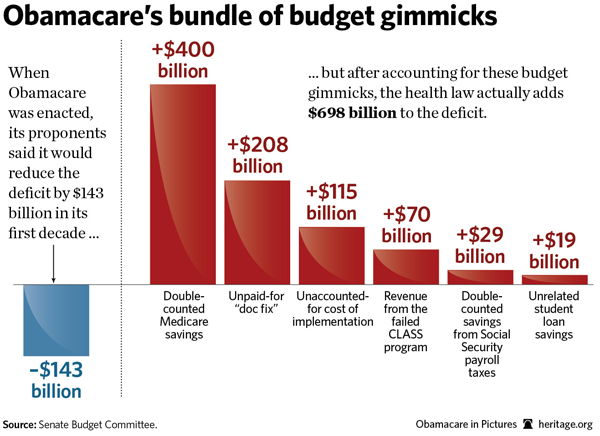
Chart: ObamaCare’s True Costs

The Heritage Foundation breaks down the numbers of what ObamaCare was promised to save, and what it actually costs:


Combine this spending monstrosity with the $787 billion stimulus bill and you’ve got nearly $1.5 trillion added to the federal deficit before any other Obama Era policy has been discussed.  Lard on the costs of EPA regulations, the uncertainty of Dodd-Frank’s implementation, and the specter of all the Bush tax cuts vanishing next January and it’s no wonder the American economy is stagnant.  The liberals in Washington, D.C. are spending and regulating us into oblivion.

April 9th, 2012 at 10:59 am
Medicaid Bankrupting States

Along with reformist former state official Bradley Byrne, I explained yesterday at the Mobile Press-Register how Medicaid is taking over the entire Alabama General Fund budget, and how ObamaCare makes it worse. This might have some bearing, tangentially, to the Supreme Court case on ObamaCare (the part argued last, about states being commandeered into ObamaCare Medicaid expansions).

Federal and state governments share Medicaid costs, but Obamacare by design will add millions nationwide to state Medicaid rolls while picking up the added costs only in the short term….

Before the $81 million error was discovered and before Gov. Bentley was forced to prorate the state’s budget (making across-the-board cuts due to revenue shortfalls), and even without full implementation of Obamacare, the state General Fund’s budget for Medicaid had doubled in just two years. To put this into perspective: During this two-year period, our court system was cut by a third, our criminal prosecutors’ offices by 14 percent, our Forestry Commission by 17 percent and our economic development by 5 percent. Medicaid went from consuming 20 percent of our General Fund budget two years ago to 36.5 percent this year. It is on track to consume the entire General Fund by decade’s end.

This is a big deal. And Alabama is hardly unique. It adds practical weight to the states’ arguments that they are being coerced into something they can’t afford.

April 4th, 2012 at 6:38 pm
Fifth Circuit Tells DOJ To Do Obama’s Constitutional Homework

President Barack Obama’s controversial warning to the Supreme Court that a vote to overturn ObamaCare would be “unprecedented” is getting push-back from the federal judiciary.

During oral arguments on a different ObamaCare provision than those argued before the Supreme Court last week, Fifth Circuit Judge Jerry Smith asked a Department of Justice lawyer for clarification.  “Does the Department of Justice recognize that federal courts have the authority in appropriate circumstances to strike federal statutes because of one or more constitutional infirmities?”

To drive home the point, Judge Smith ordered DOJ to provide a written explanation of its views “no less than three pages, single spaced.”

The only problem with the homework assignment is that it wasn’t directed to the right person.  President Obama, that one-time constitutional law professor at the University of Chicago, should be the one sitting at the keyboard relearning first year law.

At least then he’d be aware that what’s truly unprecedented is his belief that federal courts are rubber stamps for his liberal agenda.

April 4th, 2012 at 9:59 am
Ramirez Cartoon: The Commerce Claws
Posted by Print

Below is one of the latest cartoons from two-time Pulitzer Prize-winner Michael Ramirez.

View more of Michael Ramirez’s cartoons on CFIF’s website here.

March 30th, 2012 at 3:10 pm
Too Big to Read May Make ObamaCare Fail

Remember in 2009 when conservatives in Congress presented an alternative to ObamaCare that would have guaranteed bipartisan support for some of the outcomes the Obama White House and its liberal allies wanted?  Had the liberals concentrated on targeted reforms instead of a gargantuan“comprehensive solution” not only would the ultimate bill have been much shorter, it would have been much easier to read and comprehend.

That’s a point worth considering since judging by the comments from the Supreme Court this week, passing health reform piecemeal would have been a far better strategy for those wanting to salvage the legislation.

Due to ObamaCare’s massive size, Byron York notes that none of the Justices actually admitted reading the entire law.  “I haven’t read every word of [the law], I promise,” said Justice Stephen Breyer on Wednesday.  Justice Antonin Scalia’s comments to an attorney defending the law were more pointed: “You really want us to go through these 2,700 pages?”  “You really expect the court to do that?”

The problem for ObamaCare’s defenders is that the Justices’ refusal to read the entire law means that they are much less likely to rule the individual mandate unconstitutional and keep the rest.  Instead, they’ll just invalidate the whole thing and have Congress start over.

If that happens, the liberal mania for “comprehensive” solutions for everything from illegal immigration to financial transactions and health care will be dealt a much-deserved blow.  You can’t interpret what you can’t define.

If the Court strikes down ObamaCare in its entirety liberals will have only themselves to blame.  Had they listened to conservatives, some of the popular aspects of ObamaCare – guarantees of coverage and subsidies for premiums – would likely be in place with bipartisan support.  Now, they may have nothing to show for what could ultimately end up being a massive waste of time and money.

March 26th, 2012 at 4:55 pm
Then Again, Maybe I Was Right Before I Was Wrong

After reading the transcript of today’s oral argument, I thought the justices seemed extremely chilly to the idea that the Anti-Injunction Act should bar the court’s consideration of the ObamaCare “mandate” case until the mandate actually goes into effect — thus making my most recent post dead wrong (if my interpretation today is right), thank goodness. A few months ago, I had dismissed the AIA argument; last week, however, I wrote that Anthony Kennedy might find it a convenient dodge. But after today, it doesn’t look like anywhere near a court majority will do so. Judging from Lyle Denniston’s summary at Scotusblog, which I read after forming my opinion on the justices’ behavior today, it seems as if that eminent court-watcher agrees.

So, if this interpretation is correct, then we do get to move on to the most important question, which is the question on the merits of whether the mandate itself is constitutional. There are three different sorts of challenges to its constitutionality; the ultimate disposition of these challenges is very much up in the air — and there are millions of Americans who care deeply enough about this case that the tension of waiting for the court’s decision will be decidedly uncomfortable.

March 23rd, 2012 at 2:32 pm
My Prediction on Obamacare Case

For what it’s worth, my prediction on the ultimate outcome of the ObamaCare case this term, even before oral arguments are made this coming Monday, is as follows:

Anthony Kennedy accepts his former law clerk Brett Kavanaugh’s ludicrous argument that the Anti-Injunction Act bars court jurisdiction on Obamacare until the mandate and its penalty are actually implemented. He does so while dropping rather clear, even if implicit rather than explicit, hints in his bare-majority opinion that if the case were able to reach the merits, he would find the mandate unconstitutional.

It might even be some sort of plurality opinion.

I know this contradicts my prediction from several months ago right here. There, I dismissed the argument on the Anti-Injunction Act. I still think it is eminently dismissable. But that doesn’t mean Kennedy won’t latch onto it. It provides a handy way to punt the issue away, which is why I think Kavanaugh provided it, knowing his former boss as well as he does. Kavanaugh’s logic was extremely tortured… but Kennedy delights in tortured logic. Alas.

March 23rd, 2012 at 12:43 pm
California Passes Blank Budgets, Fills in the Details Later

Remember when Nancy Pelosi said of ObamaCare that Congress would need to “pass the bill so [the public] can see what is in it”?  Two years ago, Pelosi & Co. refused to make the contents of ObamaCare public until just before voting was allowed on the bill.

Well, it looks like Pelosi’s fellow liberals in California state government are doing her one better.  From the Los Angeles Times:

In an annual quirk of California government, lawmakers approved 78 budget bills on Thursday — and they were all blank.

The bills function as shells. As negotiations continue and tax revenues are tallied, they will be amended with actual budget details, then quickly passed by the Legislature and signed by the governor.

Calling this practice a quirk obscures the fact that California’s big-spending liberals are deliberately perverting the legislative process to hide their intentions.  Just like ObamaCare, California’s majority Democrats negotiate with themselves behind closed doors and demand an up-or-down vote on budget bills within hours of making them public.

This kind of process-destroying behavior cannot be allowed to continue.  The public needs accurate information to judge policies and politicians, not shell games that cost billions.

March 23rd, 2012 at 12:16 pm
House Republicans Vote to Repeal IPAB

With the Supreme Court getting ready to hear arguments about the (un)constitutionality of ObamaCare, House Republicans yesterday voted to repeal the Independent Payment Advisory Board (IPAB), one of ObamaCare’s provisions that may be left unaffected by the Court’s decision.

As the Washington Times reports, this is “the 26th time the House has voted to partially or completely repeal the sweeping overhaul” of the health care industry.

Like the other 25 times, this House vote won’t be seconded by the Democratic controlled Senate.  But in an election year that’s hardly the point.  What matters right now is that House Republicans continue to highlight how elements like IPAB destroy freedom and choice in health care by letting 15 unelected bureaucrats instead of the free market decide the price of services.

On to number 27!

March 23rd, 2012 at 9:49 am
Podcast: Townhall.com Political Editor Opines on ObamaCare
Posted by Print

Just days away from the U.S. Supreme Court oral arguments in the seminal ObamaCare case, Townhall.com Political Editor Guy Benson discusses recent polls showing the depth of American opposition to the legislation and alternatives that should be considered.

Listen to the interview here.

March 14th, 2012 at 3:56 pm
CBO: ObamaCare to Cost Nearly Twice As Much As Promised

Newsmax.com reports:

The gross costs of the national healthcare law rammed through Congress by President Barack Obama will reach an estimated $1.76 trillion over 10 years – nearly twice the amount originally projected.

The figure, which the Congressional Budget Office (CBO) revealed on Wednesday, is bound to cause embarrassment to the administration as it comes just as debate on ‘Obamacare’ is starting to heat up again, two weeks before the Supreme Court is set to hear arguments on whether the Affordable Care Act is unconstitutional.

Truth be told, nearly everyone already knew that the cost estimates used to sell ObamaCare to the American people were part of the White House shell game to get it passed.  That much is understood by both supporters and opponents of ObamaCare.  What is embarrassing is the administration’s response to the latest CBO estimate.

‘The bottom line is clear: the Affordable Care Act will reduce our deficit, control health costs and make health care more affordable,’ Jeanne Lambrew, deputy director of the White House office of Health Reform, wrote on the White House blog.

Remember, this is the same White House trying to convince you that algae is the answer to rising gas prices.

March 13th, 2012 at 2:33 pm
New HHS Rule is Roadmap to Nationalized Healthcare

Reuters explains how a new Health and Human Services regulation announced today on the state-directed health insurance exchanges lays the groundwork for a total government takeover of the healthcare industry.

In a 642-page final rule, the government provides guidance on how states should establish exchanges, qualify health plans for participation and determine the eligibility of both individuals and small businesses that want to use exchanges to provide health coverage to their employees.

Industry and consumer groups welcomed the regulations, saying they provided states with the flexibility necessary to meet consumer needs for choice and quality protections. They also said the regulations shift policy focus to the state level, where the new rules must be implemented.

That is, until States drown in a sea of future regulations interpreting and implementing this “final” rule.  At that point, States will be happy to cede control over policy details to federal bureaucrats so long as the money keeps flowing.

As an example, just look at the rush by States to accept extra-legal requirements like the Common Core curriculum standards from the Department of Education in exchange for No Child Left Behind waivers.  Implementation of ObamaCare will be no different.  Unless the law is repealed, elements like health care exchanges and IPAB will eventually turn over all healthcare decisions to central planners; first in state capitols, then in Washington, D.C.